
Bullying in a Multiple Cat Household
Last Updated on January 4, 2026 by Holly Anne Dustin
Do you have a bully cat? Bullying in a multiple cat household is one of the most common problems cat guardians have to deal with. In nature, cats would have to compete for resources and territory. In the multiple cat household, bully cats do the same.
Bully cats can come in all shapes, sizes, ages, and genders. Bullying and aggression are one of the principal reasons people surrender cats to shelters. According to one study, 27% of surrendered cats were relinquished because of issues with aggression.
If your cats are fighting, there is obviously a bullying problem. But not all inter-cat aggression is obvious. Passive bullies are sneaky. But they can make life hard for their roommates in a lot of ways.
Subtle actions like guarding food and water dishes, preventing their victims from using the litter box, blocking access to prime sun puddles or toys, or even you, are symptoms of passive aggression.

This post may contain affiliate links. Life and Cats is a Chewy affiliate and a member of the Amazon Associates program and as such we earn a small commission when you shop through our our links and banners. It doesn’t change the amount you pay. You can read our full disclosure policy here.
Contents
- 1 Play Aggression
- 2 Understanding the Aggressive Communication of Bully Cats:
- 3 The Victim Cat:
- 4 The Most Common Bullying Scenarios with Cats Include:
- 5 Reasons for Aggression in Multiple Cat Homes
- 6 How You Can Help Prevent Bullying in Your Multiple Cat Household
- 7 What to Do if You Already Have a Multi-cat Aggression Problem
Play Aggression
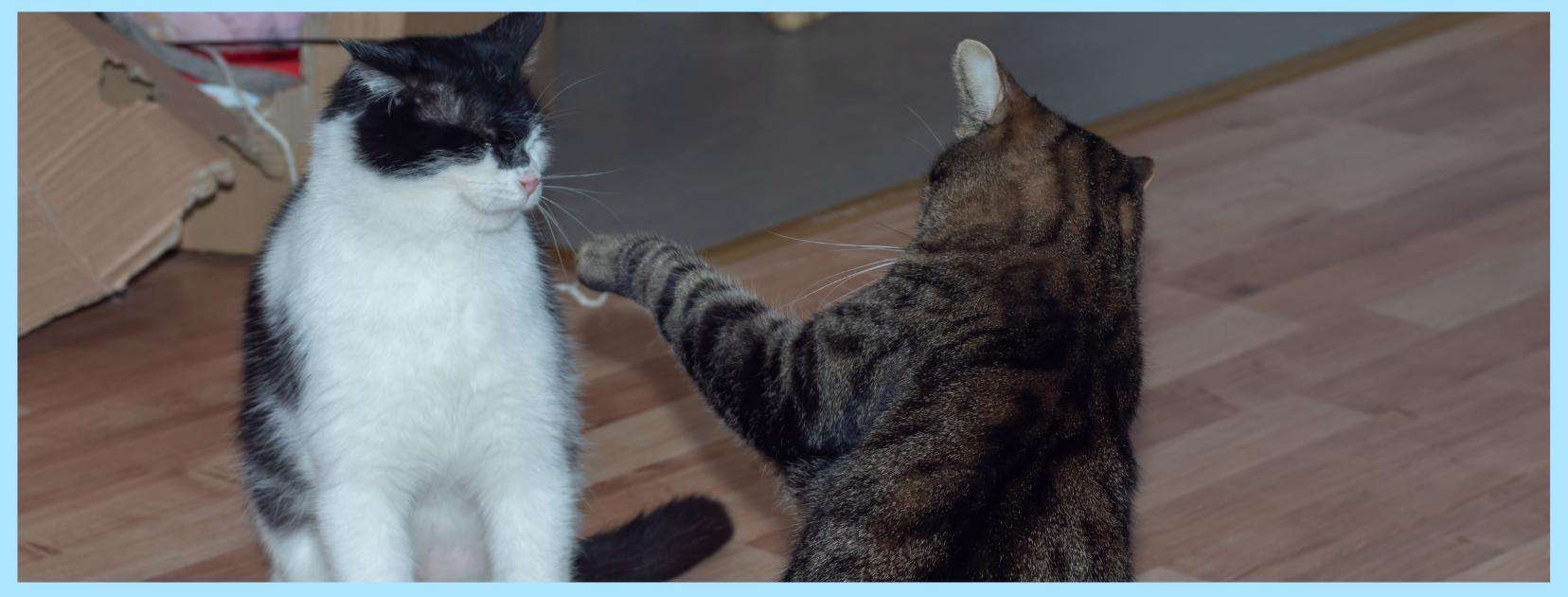
Sometimes it’s tough to tell the difference between cats that are playing and cats that are fighting, especially with kittens. Kittens naturally play rough. They stalk and chase each other, sneak around corners and pounce on each other, ambush, attack and bite each other. But is it all fun for both of them?
If they are playing, they take turns. If they hiss or growl when the other cat is near, then things are getting too intense. Cats rarely puff up their fur, growl, or injure each other when they’re playing.
Understanding the Aggressive Communication of Bully Cats:
Cat guardians can misinterpret aggressive cat communication until the fur flies or one cat is hiding under the bed all the time.
Aggressive cats can hiss, or growl every time they walk past each other. They might bite each other on the neck. Or it might be subtle with one cat sitting and staring at each other until one pounces. Their ears and tails can tell you a lot about their feelings.
The Victim Cat:
Some cats are just drama queens and invite bullying. I have one of these guys. They slink around, flop over dramatically, using submissive body language. The more the cat responds this way, the more the bully will ‘up the game’. These victim cats tend to develop stress-related illnesses.
The Most Common Bullying Scenarios with Cats Include:
- New cat attacking resident cat
- A cat bullying a new kitten or a kitten bullying an adult cat
- Multiple cats in the household bullying one cat
- An outdoor or stray cat bullying a household cat
Reasons for Aggression in Multiple Cat Homes
Lack of Resources:
There are bound to be problems if the cats feel they have to compete for access to food, water, litter boxes, and personal space.
The most important resource in a multi-cat household is the litter tray. But it could be a food bowl or a scratching post we expect them to share.
Changes in the Family:
Any changes in the family can set off bullying in a multi-cat household. It could be a new feline family member, a puppy, or a significant other moving in.
A new human sibling can create stress and lead to aggression if Kitty isn’t properly prepared.
Changes in the Environment:
Moving house, new furniture, or rearranging spaces can stress out aggressive cats. Especially if the rearranging involves Kitty’s feeding stations or litter boxes.
Redirected Aggression:
Redirected aggression is one of the scariest types of aggression. Kitty takes her stress and fear out on another cat or a person. A stray cat in the yard sets off a fight between your resident cats. Or Kitty freaks out and ends up hitting out at you.
Non-recognition Aggression:
A housemate coming back from the vet can make Kitty act out like the aliens have landed. Best friends can suddenly become enemies. This is usually a fairly easy type of aggression to correct with a quick reintroduction.
Medical Problems:
Illness or pain can make Kitty aggressive. A vet visit is the first step if your furbaby suddenly starts acting aggressively, especially if he’s an older kitty.
Social Changes:
Young cats have to find their place in the social hierarchy of your multi-cat household. If the bullying starts when a cat reaches age 1-3, the young cat may have started to challenge his elders to find his place in their cat society.
Sexual Tension:
Intact male cats and females coming in and out of season strain relationships in the multiple cat household.

How You Can Help Prevent Bullying in Your Multiple Cat Household
Spay or neuter your cats.
Add more resources so your cats don’t have to compete for limited territory. Follow the one per cat plus one rule (2 cats = 3 litter boxes, 3 scratching posts, 3 feeding stations etc.) Make sure you have enough toys, cat trees, places to get up high, and hiding spaces so they don’t have to pass each other. Jackson Galaxy calls it the cat superhighway.
Play with your cats. Sometimes aggression results from pent-up energy. Some cats have a high prey drive or greater energy than others. A pairing of a young, high-energy cat with an older cat can be difficult.
Consider the breeds you are combining: a busy Bengal and a placid Persian is probably not going to be as successful as two cats with similar energy levels.
Do not reward aggressive behavior. Distract with toys. Reward them with treats and love when the cats stop the aggressive behavior.
Try adding Feliway and calming treats.
If all else fails, you could try medication.
What to Do if You Already Have a Multi-cat Aggression Problem
Try Reintroducing the Cats:
This is especially effective with non-recognition aggression. Your cats need to get to know each other again. Usually it will resolve in a short time. It will take longer to sort out if it is a more entrenched problem.
Break the Warring Cats Up:
As a last resort before re-homing a cat, you can separate areas within the house. Screen doors or microchip cat doors can keep a bully and his victim separate and safe. Be sure both spaces have adequate scratching spaces, climbing spaces, hiding spaces, litter trays, and feeding stations. Playtime and cuddles need to get shared equally.
Deter Any Stray Cats:
Prevent redirected aggression by scaring off stray cats and other animals that wander in your yard. There are motion activated lights, sprinklers, or noise deterrents and fencing options that can help.
Don’t Break up a Fight Physically:
Instead, try to distract your cats. You can do this by clapping your hands, trying to distract them with toys, shaking a can of coins, or making a loud banging noise when you are out of sight of both cats. This should distract them and put a stop to the fighting. If you need to break up a fight, use a piece of cardboard to separate them.
Never Let the Cats “Fight it Out:”
Cats don’t make friends through fighting. In fact, the fighting usually just gets worse. Cat fights can quickly get out of hand and can easily cause injuries to one or both of the cats involved. Or to us humans if we get in the way.
Don’t Punish Your Bully Cat:
Spraying Kitty with a water bottle, yelling, or throwing things at him will not solve his poor attitude and will cause him to fear you. That just leads to stress and increased aggression.
Most aggressive cats can adjust their behavior and discover a new best friend. Inter-cat politics and bullying in a multiple cat household can work out, but it takes effort on our part to help the cats out. Training, interactive play, and strategic interventions will have our furry friends purring away together soon. Or at least learning to tolerate each other.