How Daylight Savings Time Affects Cats and How You Can Help
Last Updated on February 28, 2023 by Holly Anne Dustin
Don’t expect to enjoy sleeping in when the calendar says it’s time to “fall back” if you live with cats. Daylight Savings Time ends at 2am on Sunday, November 6th in 2022 and “spring forward on March 13th, 2023. All our electronic devices will automatically adjust for us. But what about the furry alarm clocks? Will they adjust?
Generally yes, but like us they’re going to be a bit grumbly until our routines and their tummies work out the new routine. And then we have to do it again in a few months when we “spring forward” and return to Daylight savings time.
In humans, the time changes can cause irritation, messed up sleep, and oddly enough, a 40% increase in heart attacks. But how exactly will Daylight Savings Time affect your cats and what can you do to help them adjust?
Contents
Change in Routine Causes Stress for Cats
Cats have the same circadian rhythms that we do. The rising and setting of the sun naturally sets a cat’s routine. Cats are normally most active at dawn and dusk. Your kitty will follow all the good sun puddles from place to place throughout the day for the perfect napping spot.
And, it’s not just the sun! It’s the moon too. The amount of light given off by a full moon lets a feral cat hunt more easily for a longer period of time. It also lets our indoor tigers have extra zoomies. If you think your cat is going nuts when the moon is full, you’re probably right.
But we set our daily schedules, and therefore our kitty’s schedule, with alarms and electric lights. Our feline friends become accustomed to our schedule rather than the one set by nature and will think we are weird when we change it.
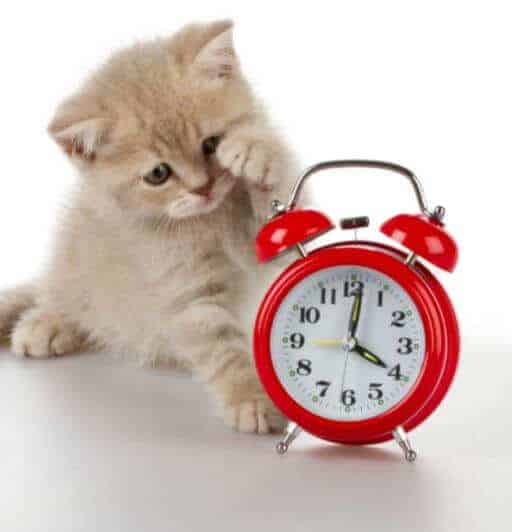
Cats are generally more routine driven than dogs. If their meal doesn’t appear at the right time they can get very stressed out.
If Kitty is used to you coming home while it’s still light out and suddenly you are coming home after dark she might get anxious. Cats with separation anxiety can really suffer.
Stress can cause behavior problems and health issues for our furry friends. She might just become more vocal or become possessive and clingy. Overgrooming, excessive scratching, and housesoiling are other behavioral signs of stress.
It is unlikely the time change will result in severe behavior problems like housesoiling. But you might see an increase in scratching behavior as Kitty works out her stress.
The most common reactions are crying and demanding behaviors. Nothing a few extra cuddles and treats won’t fix. Most cats will adjust in a week or so, just like we do. If it seems your furbaby is having a harder time adjusting than most, try a calming treat for a couple days to smooth things out.
How We Can Help Our Cats Adjust to Daylight Savings Time
We can help make the adjustment to Daylight Savings Time less stressful for Kitty by moving her meal times 10-15 minutes a day during the week prior to the time change so it isn’t so drastic an adjustment.
Do the same with any other time driven routine like a play session or bedtime (if Kitty sleeps in a specific location.) Run some errands or work overtime to set her up for you coming home later. Leave a light on for her so she isn’t left in the dark wondering what is going on.
One significant issue with the time change is certain medications. If your kitty is a diabetic, for example, it is important to keep her on schedule. Ask your vet how to adjust Kitty’s meds to the time change.
Kitty will adapt to the differences just as you do. Just don’t expect to enjoy that “fall back” extra hour of sleep when the clocks change, Kitty’s belly will still be telling her it is time for breakfast. She’ll be sharing that information most by insistently singing the song of her people or running around on your bed.