Why Are My Cats Fighting?
If you have a household with multiple cats, you know cat fights happen. Even if your cats get along, they can still fight. While cat guardians may not completely understand why their kitties are fighting, the cats will have their reasons. Cats express their discontent with other cats by picking fights. Understanding the reasons cats fight can help you prevent your cats from fighting in the future.
Contents
Fighting for Territory:
Many cats fight because of their territory. One reason that cats fight is because they feel like an unwanted cat has invaded their territory, even if it is a cat that has lived with them for a long time. Cats are much more territorial than dogs, and the gender of the cat has very little to do with it. Contrary to what many people believe, female cats are sometimes just as territorial, or more so, as their male counterparts are.
If you have two cats in your home, you might notice that one cat hisses and swats at the other whenever he feels it has invaded his home territory. It could be a favorite chair or perch on the cat tree. Or your lap. Encourage your new furbaby to find a special place of her own by finding a separate spot by adding a blanket with her scent on it.
Sometimes sensitive cats will react aggressively to a cat who went to the groomer or the vet. Blending their scents with yours will remind them they really love each other. Separate them for a bit if they don’t calm down.
Obviously, the most obvious example of territorial invasion is bringing a new cat or dog into the home. Blending your pets into a harmonious multiple cat family requires providing them with support and a proper introduction. Don’t just let them “fight it out.”
Related Post: Click the link to read our post on the proper steps for introducing a new cat to your home.
Fighting for Resources:
Cats don’t really like to share. To have a happy multi-cat home, you need enough litter boxes, scratching posts, toys, beds, places to get up high, places to hide, and feeding stations that one cat can’t terrorize another over resources. You and your attention are also a resource for your kitties. Be sure there is enough of you to go around.
Social Ranking:
Cats frequently threaten and fight with each other for social ranking. Despite what you may think; even females and neutered males do this. In a multiple cat family, one cat, usually a male, is at the top of the cat hierarchy. Expect chaos for a bit if the family dynamic changes by adding a new cat, a young cat reaching maturity, or the top cat becoming ill or passing away. The cats will fuss and scuffle with each other as they try to re-order their ranking.
The lowest-ranking cat can become a target for those trying to get to the top. Acting like a victim by slinking around, using submissive body language, hiding, and so forth invites the bullies to pile on. I have seen this happen several times in my large multi-cat household. We eventually gave Fireball his own room because everyone else was bullying him.
Related Post: Bullying in a Multiple Cat Household
Frustration:
Chaos or changes in the household routine, like renovations or someone returning to work, can also cause Kitty to lash out at her friends. When a significant change takes place, try to stick to your cats’ routine as much as you can, especially mealtimes. Give them some extra playtime so they aren’t as upset. Be patient; it might take a little time to adjust.
Redirected Aggression:
Redirected aggression is another reason cats fight. This is quite common, especially with indoor cats. Redirected aggression occurs when a cat is upset by another animal but is unable to attack it directly. For example, your cat is sitting on a windowsill and sees another cat strolling through the yard. Your cat becomes very agitated, postures, hisses, or growls.
If another family cat walks into the room, he is likely to get attacked. Sometimes this completely derails the relationship between those cats. In that case, separate them and wait until the cats are calm before reintroducing them.
Approaching an angry cat is dangerous. When Kitty is agitated she won’t hesitate to attack you either. Use a blanket, carrier, piece of cardboard to move her into a darkened, quiet space until she chills out.
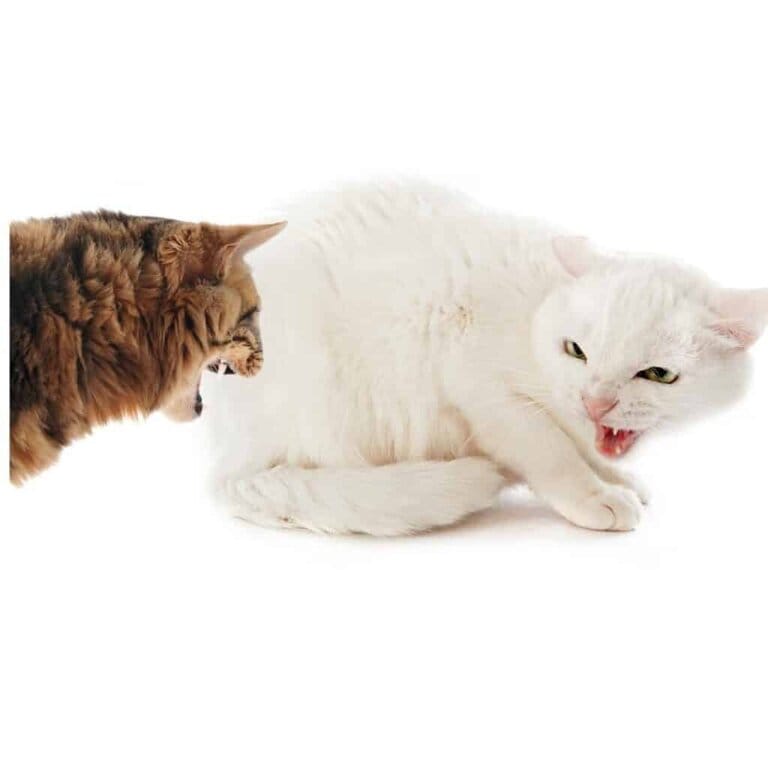
Are My Cats Fighting or Are They Playing?
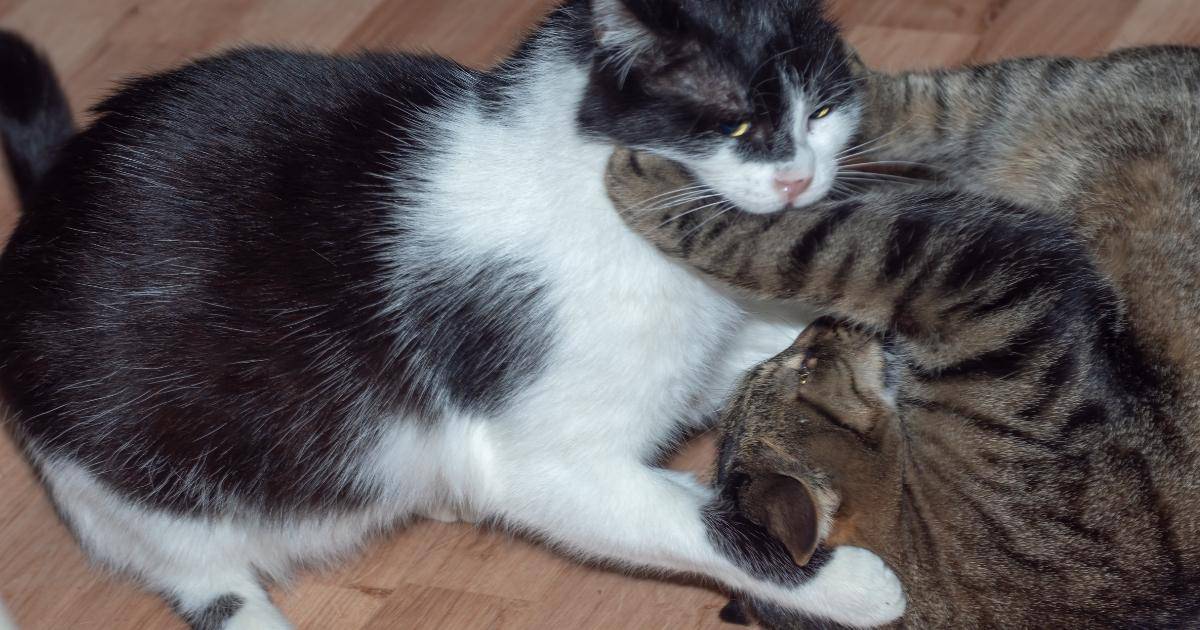
Two cats might posture their bodies, then howl and scream at one another. If one cat walks away or backs down, then they are unlikely to fight. However, if neither cat wants to throw in the towel and surrender, one cat will attack the other by jumping forward and attempting to bite the neck. The other cat will fall on his back and try to bite or scratch the attacker with its hind legs. The two cats might go through this several times before walking away.
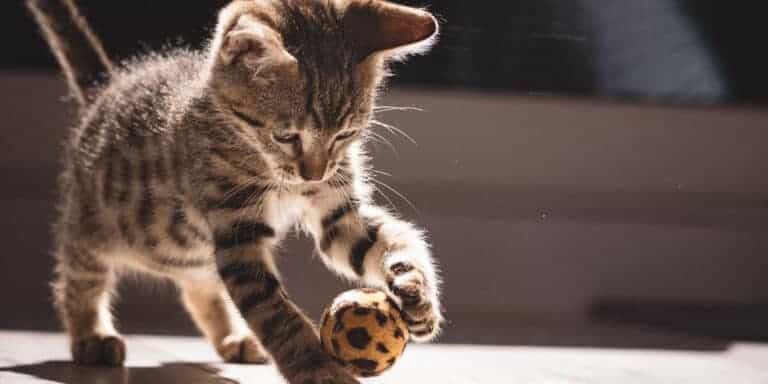
Cats are rough when they play. This may look like aggression and fighting, but it is not. You may even notice that kittens or young cats play with one another this way. Cats that are play fighting take turns, letting one cat be at the bottom of the wrestling huddle and then the other. They might even take brief breaks to rest. If your cats’ bodies are relaxed or their ears are pointed forward, they’re likely just playing. Most of the time, you will not need to interfere.
But if your cats flatten their ears, hold their ears back, or puff up their fur or tails, this is a sign that they’re fighting, not playing. If they lean away from each other while hissing with bared teeth, your cats probably feel threatened and aren’t having fun. Chasing a tired cat until it hides could also be a bad sign. Inflicting injury is another sign things have gone too far.
How to Stop a Cat Fight:
Most of the time, you can tell whether your cats are fighting for “blood” or just playing around. The time to stop a fight is before it gets really nasty. If you feel the need to stop a cat fight, then you should do it carefully. Even the most loving cat can bite or scratch you in aggressive passion.
Try to distract the fighting cats with a toy or some kind of loud noise, such as a hand clap or the hiss of canned air. Usually, they will stop to see what is making the noise. If they aren’t willing to walk away at that point, throw a thick towel or blanket over one of the warring kitties and removing him from the scene until calm is restored.
Related Post: Read for More Tips on Living with Multiple Cats
Don’t Overreact if Your Cats are Fighting:
If your cats are fighting occasionally, you should know that this is quite typical of cats. Don’t punish Kitty for fighting. She won’t understand and it will just make her more fearful and aggressive. Likewise, don’t try to calm the victim. Just separate them and give them space.
But if they are fighting more than they should, it is time that you find out why.
- Were they not introduced properly?
- Are they trying to figure out their place in your multi-cat household?
- Do they need more time and attention from you?
- Do they fight over a litter box, a food bowl, or a prime window location?
Many of the scenarios that would cause cat to cat aggression can be managed by changing Kitty’s physical or social environment. For example, making sure each kitty has his or her own “things” and a place to retreat to when they feel overwhelmed. This will go a long way in preventing serious cat fights.