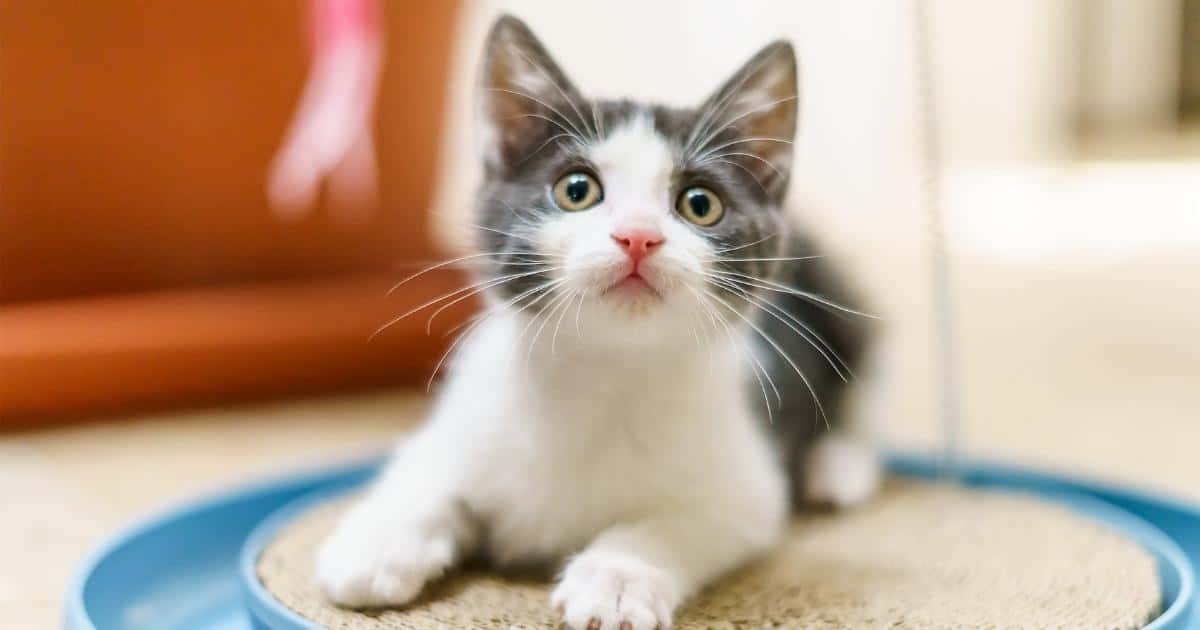
Prevent Boredom with Sensory Enrichment for Cats
Last Updated on December 30, 2025 by Holly Anne Dustin
Is your kitty driving you crazy, yowling for no apparent reason? Attacking your kids’ ankles? Scratching everywhere you don’t want him to scratch? Or worst of all, peeing outside the box. All these behavior problems could have many causes, but one of them is boredom. After a vet visit to make sure Kitty is healthy, look at Kitty’s daily life. If he spend all day sleeping, free feeds kibble from a bowl you fill when it’s empty, and his time with you is basically watching TV after work and snuggling in bed, then it is definitely time to look at adding some sensory enrichment for cats to his environment.
Contents
What is Sensory Enrichment?
At its core, enrichment provides cats with species appropriate activities that reach their core “cat” or inner tiger. It allows cats to interact with their world in a way that is natural to them. It is not a single specific event, it is an overall process. Sensory enrichment is simply focusing on reaching Kitty through all of their 5 senses.
Why Use Sensory Enrichment?
You most often hear about environmental enrichment making life better for cats in shelters. But we can use the ideas to give our own cats their best life possible.
Sensory enrichment activities, like all enrichment, provide Kitty with physical exercise and mental stimulation that will reduce boredom and stress and the resulting likelihood of destructive or nuisance behavior problems.
People think they’ll get a cat because they are low maintenance, self sufficient, independent animals, but cats really need to express their natural behavior to truly thrive. Our pampered indoor cats are safe, but spend long periods of time alone and unable to exhibit normal hunting or social behavior. Lest you think I am advocating outdoor cats, I am not. I am unapologetically in favor of keeping cats inside with controlled access to outdoors in catios or on leash and harness. But since Kitty cannot control his own environment, it is up to us, his human guardians, to meet his needs beyond food, water, and a clean litterbox. Or suffer the consequences of a bored, stressed out cat.
An environmental enrichment plan makes your home a positive place for Kitty and increases his ability to cope with challenges such as including the introduction of a baby or other animals, construction, or his person going back to work or school.
Related post: Outdoor Enrichment for Indoor Cats
What to Consider When Setting up a Sensory Enrichment Plan:
- It is not a once and done thing. Cats get bored, or “habituated” as the studies say, easily. Change it up as you go. It can be as simple as changing the color of the toys you give Kitty.
- An activity is only enriching if the cat enjoys it or interacts with it. It’s no good putting up a birdfeeder if the cat doesn’t care to sit and look out the window.
- Pay attention to what activities your furbaby responds to best. Create a plan unique to her. For those of us with multiple cat families, we need to think about each cat separately. If Tiger likes a good catnip party and Midnight prefers to play fetch, it’s important to work both those activities into your enrichment plan for the week.
- Consider how different games affect each cat when you put together your plan.
- You need to consider any limitations of your baby if you have a special needs cat. Ramp up the activities that use her other senses.
- Adult cats need 30 minutes of interactive play daily. You can break it up into shorter sessions throughout the day.
- Kittens play for about an hour a day. Keep it to 5-10 minutes a session for your little cats.
Click here to learn more about your cat’s five senses
Ideas for Activities to Include in Your Sensory Enrichment Plan:
This post may contain affiliate links. Life and Cats is a Chewy affiliate and a member of the Amazon Associates program and as such we earn a small commission when you shop through our our links and banners. It doesn’t change the amount you pay. You can read our full disclosure policy here.
Visual Enrichment
In a study done at Queen’s University in Belfast, they considered visual stimulation the most effective environmental enrichment. Specifically, they found that toys that mimic prey and linear movement were the most enjoyable.
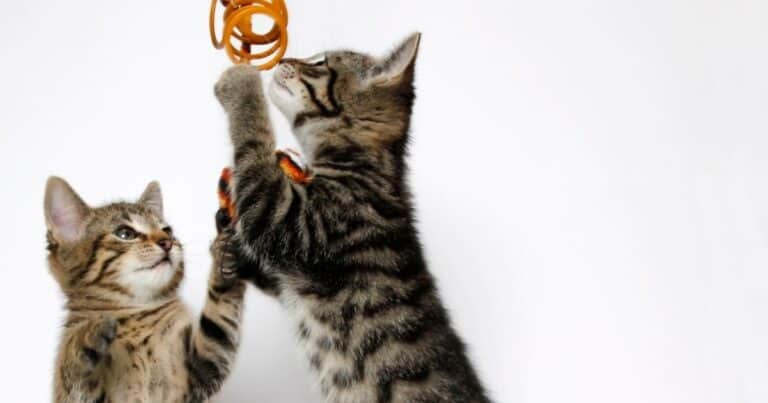
Cats see differently than we do. When they hunt or play hunting games with us, they focus on movement. So a wand toy that skitters along like a mouse, or flies like an insect, will engage Kitty and trigger her instinct to pounce on her “prey.” Let her win the game before you stop playing. If she never catches that prey, she can get frustrated, which can build up into aggression. She may decide to catch you instead!
Related Post: Through a Cat’s Eye
Provide Kitty with interesting things to look at. A window perch to watch the wildlife – or people watch if you live in the city, a bird feeder, or an aquarium will let Kitty have a taste of her natural world. TV designed for cats can enrich some cats’ lives, but not all cats are interested once they figure out it is just a screen.
Other ideas for visual enrichment include mirror tiles on the wall at cat height, mobiles made from CDs or mylar ribbons. The light reflecting off the shiny surface will reflect sparkling light on the wall. Some cats will chase them, but others just like to watch the dancing light. Bubbles, pinwheels, fidget spinners are other options. Switch out the ball in your cat’s turbo track toy for one that lights up and flashes and make the toy even more interesting.
Playing with color is another way to provide visual enrichment. Cats do not see the full spectrum of color. They see blues, yellows, and greens the best, so lean into those. Color makes a difference. One study on visual enrichment offered a selection of toys. The subject kitties got bored with the selection. The researchers changed one toy to a different color model of the same toy and the cats were interested again.
Related Post: Best Enrichment Products for Cats
Auditory Enrichment
Have you ever seen your furbaby stare at something you can’t see? He’s probably hearing something you can’t. Cats hear better than we do, even better than dogs hear. They have one of the largest ranges of hearing of any mammal.
Since we have a furry friend with super hearing, it’s important to provide auditory enrichment. We also have to consider how sensitive their ears are. Avoid loud or intense noises, like your teenagers’ music. Instead, provide low energy, calming sounds like classical music. There are a few companies that offer music specifically made for cats: ThroughACat’sEar and the iCalmCat system are the big ones. You can find some cat friendly music on YouTube as well.
Nature sounds make good auditory enrichment for your cat. If you live in the country, just open your window and let them hear the birds sing. The nature videos may not please them from a visual sense, but the soundtrack of small rodents and birds likely will.
Water fountains are great for increasing hydration but, if you get one that has a quiet motor, the trickling water can provide auditory interest.
Toys that crinkle, rattle, or squeak with prey-like sounds all make playtime an auditory buffet.
Olfactory Enrichment
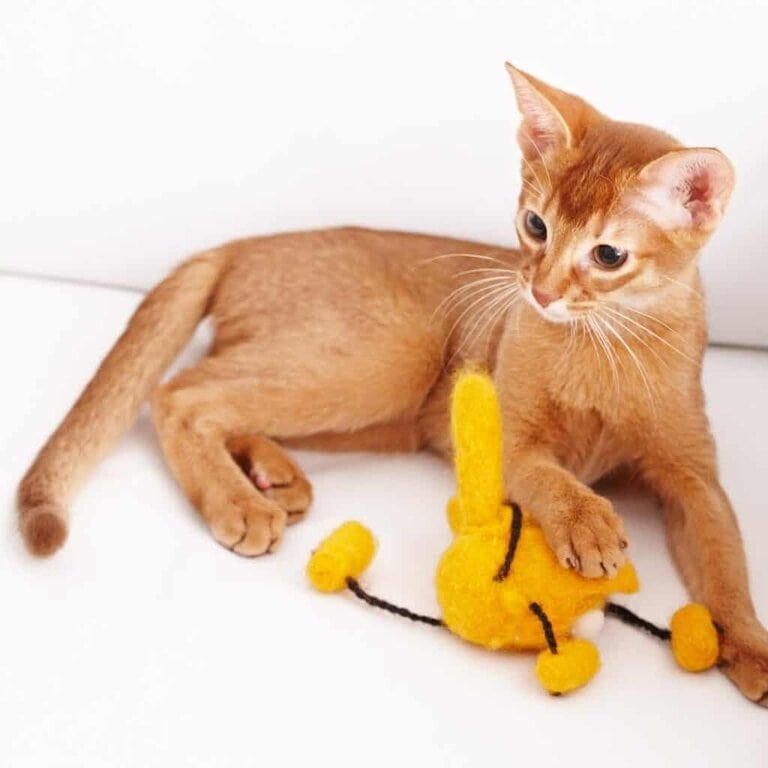
If a cat’s sense of hearing is one of her superpowers, her sense of smell is really spectacular. Cats have over 200 million odor sensors in their noses. Kitty smells 14 times better than you! Think about that next time you don’t clean the litterbox.
Scent is obviously important for sensory enrichment for cats. Give them a variety of places to rub and scratch to mark with their scent. Having their own scent around them calms kitties and makes them happy. Scratch posts and pads, the plastic groomer tools that attach to corners of walls, toys like the Catit massagers all help meet these needs.
Expose Kitty to fresh smells to excite her curiosity. You can make games out of scent work. Take a scrap of fabric and apply a drop of scent. Take care if you use essential oils. They are strongly concentrated and repel cats. Many oils aren’t safe to use with cats. Try hydrosols, extracts, or highly dilute safe essential oils before using them.
Herbs are another way to bring scents to provide olfactory enrichment for Kitty. Catnip, silvervine, and valerian are well-known cat attractants, but honeysuckle is another plant with similar properties. The berries, and possibly the leaves, are poisonous. It is best used with the wood in a toy or as a spray.
Cats may enjoy the smell, and taste, of common kitchen herbs. Safe options include dill, oregano, parsley, and rosemary. Some cats react to olives as they do to catnip.
You can offer cat-safe garden plants and greens like grasses, dandelions, sunflowers, snapdragons, zinnia, and roses minus the thorns of course for Kitty’s sniffing pleasure.
A leash and harness trained kitty can enjoy a walk through a garden or some place with unfamiliar smells to explore. Controlled access to an outside environment can provide enrichment for all Kitty’s senses.
Gustatory Enrichment
The sense of taste is an easy way to enrich your cat’s life. Offering different flavors and textures at mealtime is one way. Making meal time a game is another. Vary where you feed Kitty. If that doesn’t work for you, at least put snacks around for her to find through the day. She will exercise her sense of smell to find her snacks and her sense of taste will enjoy the reward.
You can take that up a notch by using food puzzles. Food puzzles like snufflemats, treat balls, activity boards that Kitty has to solve to get her food. Providing something for your cat to sniff out and “hunt” is gratifying to their need to complete the hunting or prey sequence. Even once they find them, they still have to work a little to get the treat out, just like they would in the wild. You can DIY your own or choose from a variety of commercial options.
Do you have a smart cat that solves puzzles super quick? Look at some of the dog puzzles for more of a challenge. Still not a challenge? Make it fun and vary what is IN the puzzle for the fun.
High value treats as a reward for clicker training offers both gastronomic value, social enrichment, and cognitive enrichment.

Tactile Enrichment
Besides petting Kitty, you can enrich his sense of touch by providing a variety of surfaces and textures to interact with. It can be a larger scale enrichment such as large cat trees to climb and scratch, a tunnel or box castle to explore, or small scale like a variety of toys.
You can provide a variety of scratching surfaces including sisal posts, a favorite of most cats, jute mats, cardboard novelty scratchers, and carpet squares in your room design.
Offering things to explore and navigate through gives Kitty exercise and a tactile experience. You can purchase a variety of tunnels, cat trees, and shelves, but enrichment doesn’t have to be expensive. Recycling paper bags and cardboard boxes will do it.
Take advantage of the wide variety of types of cat toys on the market. Choose toys that Kitty can pick up and carry around, throw, bat about, chase and play fetch. Vary the material of the toys too.
Don’t overwhelm your furbaby with too many toys to choose from. He’ll have less interest in playing if he doesn’t know where to start. Cats are more enriched when their toys are rotated and changed up. It’s like getting brand new toys when they see a toy that you’ve had marinating in catnip for a few weeks.
Water play can provide tactile enrichment for cats that enjoy it. It can be as simple as dropping a toy in the bowl to see what it does. Some cats will play in their fountains. My Midnight liked to take fountains apart for fun.
Gentle grooming can be a wonderful bonding experience. Bonded cats groom each other. It is also a way to share a tactile enrichment and social experience. Vary the tools. A rubber brush can provide a nice massage. A comb and brush feel different.
Visual stimulation, particularly that combining elements of prey items and linear movement, was considered the most effective type of environmental enrichment. Olfactory stimulation in the form of catnip also offered welfare advantages, promoting play and behavioural diversity. Auditory stimulation had inconclusive results on the behaviour of the sheltered cats, and at this stage is not recommended as a form of environmental enrichment for such animals.
Sensory enrichment for cats housed in an animal rescue shelter Queen’s University Belfast
How to Design a Sensory Enrichment Plan
Making an enrichment plan is simply planning out the activities you are going to offer your cats. While it is more often used with socialization volunteers in shelters, you can use the idea at home too. It is one way to ensure that you offer your cat activities to reach all his senses. A schedule of enrichment activities will be more beneficial to the cat than random acts of interaction. But that shouldn’t mean that your scheduled play time is the only time you have an intentional interaction with your cats.
Want a chart to help design your cats enrichment plan? Click here to download
Consider the activities that your cats like, don’t like, and how they react to certain stimuli. For example, I needed to consider that my Midnight got mean if he had too much catnip and electronic toys scare Matisse. Plush loves to watch TV but the rest of mine don’t care about it. Minnie will play cat video games on my tablet but they frustrate Tiger. Laser tag makes Musette angry and aggressive. Puzzle toys have to be something they can’t just flip or push over to get the reward.
It doesn’t mean we can’t do those activities, it just means I have to be more creative about it. Midnight gets catnip alone, Musette gets to “kill” a treat at the end of a laser tag game instead of just stopping the game.
Related Post: Help! My Cat is Bored
Summary:
Sensory enrichment as part of an overall enrichment plan offers cats physical and emotional benefits. The opportunity to use all their senses provides them with mental stimulation, reduces stress and boredom and prevents problem behaviors. Playing and interacting with Kitty strengthens your bond. She will be happier, healthier, and more fun to live with.
Sources:
Object play in adult domestic cats
Influence of visual stimulation on the behavior of cats in shelters
Sensory stimulation as environmental enrichment for captive animals
Sensory enrichment for cats