
11 Healthy Tips to Get Your Fat Cat Slim
Last Updated on May 27, 2021 by Holly Anne Dustin
It is important to help your cat lose weight. Overweight cats are at risk for arthritis, hip dysplasia, high blood pressure, heart and lung disease, ruptured ligaments, respiratory issues, compromised immune systems, liver disease, and some cancers.
Cat obesity is a serious health problem. The Association for Pet Obesity Prevention (APOP) estimates that 57% of cats are overweight or obese. That means 50 million cats are over their ideal weight leading to health concerns ranging from diabetes to heart disease.
An extra 2 pounds puts a cat at three times greater risk for developing diabetes. Obese cats are tired and inactive. You can read more about obesity and the associated health risks in our post here.
Contents
Is Your Cat Obese?
Sure, we all think chubby cats are cute. There’s even a social media movement: the Chonk. But it isn’t healthy for Kitty. We want him to live a longer, healthier life not get a big ‘Gram following for being “chonky.”
You need to know Kitty’s body condition before you know how much weight he needs to lose. You can use the body condition tool to give you an idea of whether or not your cat needs to lose some pudge. A score is a number assigned to a cat’s body type ranging from 1-9, with 1 being very underweight and 9 being very overweight.
Ideally, your cat will have a body score around 5.
Your vet will assess any health-related issues for weight gain beyond just overfeeding and under-exercising. The vet can also help with conditions like arthritis or heart disease that make it harder for Kitty to exercise.
Help Your Cat Lose Weight and Develop a Healthy Lifestyle
This post may contain affiliate links. Life and Cats is a Chewy affiliate and a member of the Amazon Associates program and as such we earn a small commission when you shop through our our links and banners. It doesn’t change the amount you pay. You can read our full disclosure policy here.
Change How You Feed Kitty
- Switch from dry food to wet food. Canned food is typically lower in carbohydrates and higher in protein, closer to what a cat is biologically designed to eat. The extra moisture helps keep him hydrated. You can add additional water to help him feel more satisfied.
- Feed more pate style food. Pate foods usually have lower carbohydrate contents and lower calories than the cuts and gravy styles.
- Stop free-feeding, switch to scheduled mealtimes. Smaller portions served more often will keep Kitty’s blood sugar levels more constant and keep him from getting hungry. Ideally, cats should be fed 4 times a day for healthy weight loss.
- Feed for weight management instead of following the feeding guidelines on the cans. A typical adult cat would eat 40-50 Kcal per kilogram times the cat’s target weight times 60-70%. He should be eating 157 Kcal per day. I don’t like math. There’s an online calculator here. You can input the body condition score your vet gives you, or use the information in the video and estimate it.
- Measure the food, whether you use wet food, dry food, diet food, or raw/fresh food. Keep the calories appropriate for weight loss.
- Use interactive feeding devices. There are slow feeder bowls to slow Kitty down and puzzles or feeding devices that simulate his natural hunting behavior.
- Let Kitty hunt for his food. Put his food in different places so he has to find it for each meal.
- Find low-calorie treats. Freeze-dried meat is awesome. Don’t forget to deduct the treats from his daily caloric allotment.

Increase Kitty’s Exercise:
Cats were created for an active lifestyle. But, just like you don’t start out exercising like a bodybuilder, Kitty needs to start slow. Especially if he’s dealing with arthritis or gets winded quickly, start out gently and up the intensity as his fitness improves. Arthritic cats might benefit from a low-impact, ground based play. They will strengthen muscles and increase flexibility in tendons and ligaments.
Playtime: Exercise is fun
Remember, your furbaby’s attention span is about 5 minutes. Shorter bursts of playtime are better than one long one, especially at the beginning. When he starts to lose interest, change the game. Don’t forget to let him win now and then.
- Let him exercise his hunting prowess. Get a wand toy and make it act like a bird or a mouse.
- Have your laser pointer act like a fly on the wall.
- Move your toy in ways that imitate the natural movement of the prey.
- Even a simple piece of string dangled behind you as you walk through your day can keep Kitty active.
- Play fetch with a favorite toy. Or let him run for a low calorie treat you tossed for him.
- Throw some ping pong balls in the bathtub for some real fun.
Rotate Kitty’s toys every week or two to keep the interest up. You can “marinate” toys in catnip in the off weeks to keep them refreshed.
Add Vertical Space
- Wall shelves, cat towers, stairs and steps give Kitty a new territory to explore. Cats like heights. They will enjoy exploring and climbing through their new areas.
- Lead him through his new playground with your wand toys.
- Leave treats or part of his meals behind for him to find as he climbs around.
Build Kitty a Gym:
An Agility Course
Both the major US cat fancy associations offer agility competitions for cats. You can find instructions for making a practice set and training your cat on YouTube. It is exciting to compete and win ribbons but you don’t have to leave home to have the fun. It is easy enough to make your own obstacles but if you’re like me and would rather buy something, you can find a basic set at Amazon.
Treadmills and Cat Wheels:
You can train your cat to walk on a treadmill with the right encouragement and supervision. Cat wheels are a more popular option to help your cat lose weight and expend extra energy. If you choose to opt for a cat wheel make sure it is well-designed and safe.
It needs to be sturdy enough to support the cats that will use it. Be sure that there is no way a second cat could get his paws or tails in the mechanism when a cat starts running on the wheel. Obviously the wheel should be balanced enough to not fall over if a couple of cats try to run together.
Be sure that the diameter of the wheel is large enough for your biggest cat. You don’t want the wheel to flex their spine inappropriately.

Get Kitty Outside
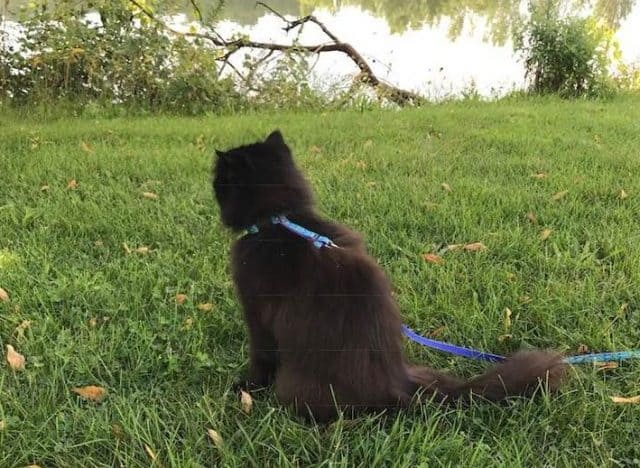
Train Your Furball to Walk on a Leash:
Some cats can develop a real love of life as an adventure cat. Rather than sleeping his day away on the couch and eating out of boredom, Kitty joins you hiking, boating, biking, or shopping.
Other cats enjoy traveling and touring. Almost all cats can learn to explore their backyard on a leash.
Build a Catio:
A catio gives Kitty free access to a safe, enclosed area. A cleverly designed catio with high shelves, logs to climb, leaves to chase, and a variety of enrichment areas to enjoy will help Kitty get some exercise as well as the fresh air and enrichment.
Weigh-in Weekly
Your vet should allow you to stop in for a weekly weigh-in for Kitty, but if that is inconvenient or too stressful you can weigh in at home. Invest in a good scale. A pediatric scale or a postal scale works well.
If you have a good digital scale that will show weight to two decimal places you can just weigh yourself then weigh yourself holding your furbaby. The difference is your cat’s weight.
Track your cat’s weight loss on a spreadsheet or an app like 11Pets.
Summary
Use the cat’s natural rhythms – hunt, eat, groom, sleep – to your benefit to help your cat lose weight. Kitty will be more active in the two hours or so before each scheduled meal. Combining that activity with a play session, and more frequent but smaller meals, will help Kitty burn off those excess pounds.
Remember in the wild, Kitty would have to hunt for his meals. Catching dinner would require work and the expending of calories before eating. Balancing the calories in and calories out will get Kitty back to his ideal weight and healthy lifestyle.
Sources