Discover the Wonder of the Curly-Coated Rex Cat Breeds
The Rex cat breed have curly, rippled, or wavy fur. There are 11 known Rex breeds of cats that are currently recognized or in the process of achieving recognition. Each breed developed independently from each other in a spontaneous genetic mutation. You also see Rex coats in other species such as rats, guinea pigs, and horses. This mutation results in soft fur with no guard hairs
Rex cats sport a variety of colors, patterns, textures, and curl types. They can have any coat length from partially hairless, short, or long and heavy, kinky to wavy. You might hear the long haired breeds referred to as “poodle cats” or “lambs” by the uninformed.
Their distinctive coats not only set them apart from other cats, but also make them incredibly soft to the touch, providing an endless source of cuddles and comfort.
But it’s not just their appearance that makes Rex breed cats special. They thrive on human companionship and enjoy being in the center of attention. Their playful and mischievous personalities will keep you entertained for hours, and their loyalty and devotion will make them a cherished member of your family.
Rex breed cats are known for their intelligence and adaptability. They quickly learn tricks and games, and they can easily adapt to new environments and routines. This makes them a joy to train and a perfect fit for the show ring and agility competitions as well as a pet in your home.
“Lama”, a slate-colored, curly-coated, cat imported from Tibet is the first Rex cat on record. He was shown at a London Crystal Palace cat show in 1892. Various Rex cats have appeared through the years but not enough to establish a recognized breed until the 1940’s.
Contents
Ural Rex Cat
The Ural Rex is probably the original Rex breed, but it didn’t make an appearance in the show hall until the early 1990s. It was officially registered by the World Cat Federation in 2006 but isn’t recognized by any of the other fancy registries. The mutation first occurred in the feral population in the Ural Mountains near Yekaterinburg.
Ural Rex cats have a thick, flat wave to their coat that gives them a fuzzy look. They are recognized in both short- and long- haired varieties. Urals are accepted in chocolate/lilac and cinnamon/fawn. They have crimped whiskers, high cheekbones, and expressive almond-shaped eyes. The breed is intelligent, affectionate, and sociable.
Cornish Rex Cat
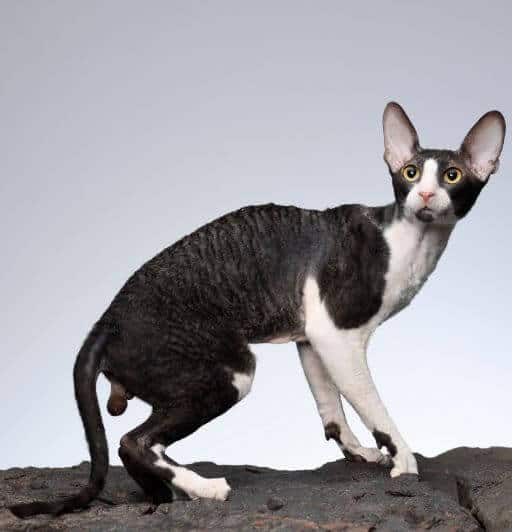
The first officially recognized Rex breed was developed from a curly-coated cat found in Bodmin, Cornwall, England in 1950. This cat’s offspring was bred with Burmese, Siamese, and British domestic short hair cats to create an active, busy, long, lean breed with large, bat-like ears.
This breed does not have fur, just the downy undercoat. The coat texture is incredibly soft, plush, and thin. Cornish Rex cats are often compared to a whippet’s build.
The German Rex
The German Rex cat is a breed of domestic cats that originated in Germany in the late 1940’s or early 1950’s. No one took any real interest in the mutation until after the Cornish Rex developed a following. The German Rex is caused by the same recessive gene which caused the Cornish Rex. It is similar to the Cornish Rex in shape and form. The cat’s coat and body style is slightly different because different breeds were used in creating it. There is a long-haired derivative, the German Angora Rex, that is not recognized. The breed is extremely rare now, even in Germany, primarily due to its genetic similarity to the Cornish Rex. The German Rex is only recognized by FIFe.
California Rex Marcel
Another Cornish Rex-related breed is the California Rex, or Marcel, cat. They were first discovered in California in 1959 in San Bernardino. The California Rex was a long haired version and had the typical Rex coat in that it didn’t have guard hairs. There was an attempt to establish it as a breed, or a type of Cornish Rex, by breeding it with a Siamese. But the cats’ coat lacked texture and the longer length hid the body type. The breed was basically allowed to die out and isn’t recognized anywhere.
The Devon Rex Breed
The Devon Rex cat also hails from England. They were first discovered in England’s Devon region in the 1960s.
Despite the fact that both the Devon and Cornish Rex foundation cats were found in nearby regions of England they are not related. Attempts to breed Devons and Cornish result in straight-coated cats. The mutations aren’t the same. The mutation that creates the Devon Rex is closer to that of the Sphynx than the Cornish. In fact, the Devon is an acceptable outcross for the Sphynx.
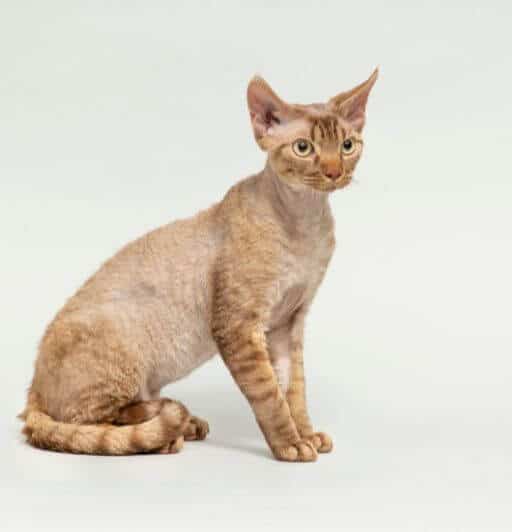
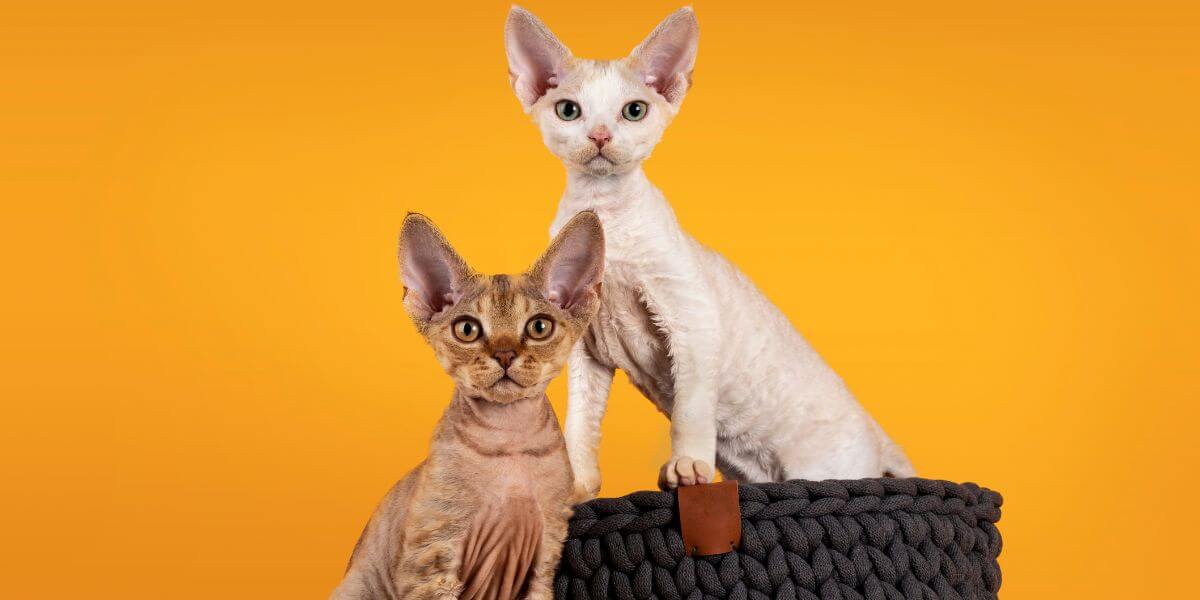
Devon Rex cats come in all patterns and colors. Their coat is more rippled than tightly curled. The Devon has a shorter, wider face than the Cornish with big, widely-spaced ears, high cheek bones and a short muzzle, creating a pointy, triangular face. They are often described as “pixies” or “elfin”. They are jumpers, climbers, energetic kitties who love their people. Devons are recognized by all the major cat fancy associations.
Related: Want to learn more about cat breeds? Click on our breeds page.
Selkirk Rex Cats
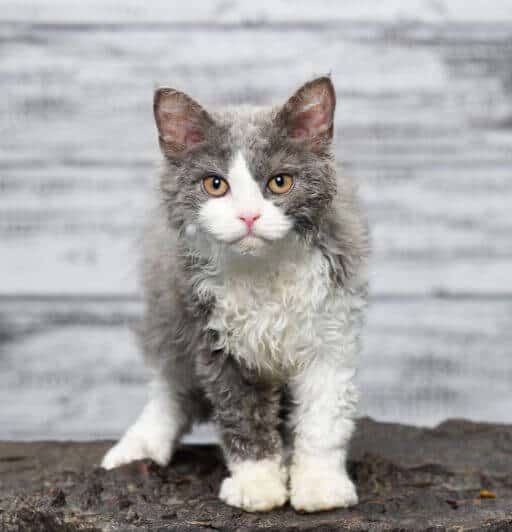
It will be no surprise that this one is my favorite of the Rex breeds. The first Selkirk Rex was discovered in a Montana shelter in 1987 and adopted by a Persian breeder. She bred the curly kitty with her black Persian. The resulting breed is a sturdy, medium-to-large cat that is recognized in both long and short coats. It had a quick acceptance, being approved for championship in 1990.
Selkirk Rex cats can have loose waves or tight spiral curls depending on their coat. Litters can have straights and curls in the same litter. A straight coated Selkirk makes a delightful entry in the household pet class. It looks a lot like an Exotic Shorthair or British Shorthair. The breed comes in all genetically possible colors and patterns. This breed might be for you if you want to own a living teddy bear.
The Tennessee Rex Cat
The Tennessee Rex is a breed under development. A pregnant stray produced a litter of kittens in 2004 in Tennessee. The cats have curly coats that also have a unique satiny or “glitter” shine similar to that found in Bengals.
The breed is not fully recognized in any association yet because there are simply so few of them. The discovery of the satin gene did increase interest in the breed. A few other spontaneous mutations have been found and used to increase the gene pool. They come in all colors and patterns. The coat is allowable in both long and short hair. The curl is more “corkscrew” style than the other rex breeds.
I watched a pair of these guys grow while we both showed in TICA shows and they are pretty darn cute.

LaPerm
The LaPerm was discovered in 1982 on a farm in Oregon. Their hallmark feature is the perm-like appearance of their fur which has a loose waviness with super tight curls on the belly and legs. They are recognized in both a short and long haired version. Although they are recognized in any color or pattern, tabbies, tortoiseshells and red cats are most common.
The breed is still pretty rare due to low breeding numbers. The LaPerm is recognized by all the major fancier associations. The LaPerm has been used as a foundation breed for breeders attempting to create curly coated breeds.
Skookum Rex Cat
The Skookum Rex breed was developed by Roy Galusha in the 1990s. It was created by crossing the LaPerm with the Munchkin breed to create a curly coated, short legged breed. It has the same wavy coat of the LaPerm in short and long hair varieties and all colors and patterns. There are very few breeders involved with the Skookum breed. It is currently only recognized as experimental.
Lambkin
Also called the Nanus Rex, the Lambkin is another experimental breeding under development. They are a crossbreed of the Selkirk Rex and the Munchkin. It is a small to medium breed with the recognizable short legs of the “munchkin-ized” breeds The breed has long and short hair varieties with the wavy or curly coat of the Selkirk Rex and is expressed in all colors and patterns. It is only recognized as an experimental breed. None of the major registries include the breed yet.
Tasman Manx
I’m sure you’ve heard of the Manx cat, the tailess breed. But a curly-haired Manx? Meet the Tasman Manx. They are described by the breeders as “appearing spontaneously in Australia and New Zealand.” The cat has a “dense and frizzled coat.” They have either stubby tails or no tails at all. Tasman Manx come in both long hair and short hair. All colors and patterns are acceptable. The New Zealand Cat Fancy is the only association that recognizes the Tasman Manx.
If you’re ready to embark on a journey filled with wonder and joy, consider welcoming a Rex breed cat into your home. Their curly coats and friendly personalities will bring endless delight to your life. Whether you’re snuggling up with them on a lazy afternoon or marveling at their unique beauty, Rex breed cats are sure to captivate your heart and leave a lasting impression. Get ready to experience the magic of these amazing felines and create unforgettable memories together!