Guess What? Your Cat isn’t a Jerk and He Really Does Love You
Last Updated on June 24, 2024 by Holly Anne Dustin
Cats are the new “human’s best friend.” The number of pet cats outnumber the number of pet dogs. But cats still have a reputation problem and it hurts cats.
People think that cats are standoffish and aloof. If you talk about training in a cat related Facebook group you should expect to be laughed at. Somehow, even cat-loving people expect cats to be “assholes,” mean, and destructive.
The thing is they have it all wrong.
Contents
Science Says Otherwise
Finally, science is beginning to study cats as cats not cats as dogs. Several studies have been done in the last few months that show that the relationship between cats and their people is indeed a deep and secure attachment and is based on communication and understanding how cats show love.
One of the leaders in the field is the Human-Animal Interaction Lab at Oregon State University. The researchers were surprised that so little research had been done on cat human-relationships.
People have been “underestimating cats’ socio-cognitive abilities.” Cats, in fact, attach to us much like human children attach to their parents despite their reputation for being aloof, stand-offish, or mean. Cats’ attachment to their humans is in some ways stronger than dogs. Cats do show they love us – and science now proves it.
The Feline-Human Bond
A 2019 study done by Oregon State University, and published in Current Biology, tested 70 cats with the same test used to prove dogs’ and babies’ attachment to their caretakers.
The cat and their human were left in an unfamiliar room for two minutes together. Then the human left the room, leaving Kitty alone for two minutes. The two minutes could be mildly stressful for the cat. Then the guardians were allowed to return.
The majority of cats were very happy when their people returned. The cats would go to their guardians and greet them. The cats were allowed to continue to explore the room. They would explore and play and occasionally check in with their people. The checking in behavior shows a secure attachment.
Cats that have insecure attachments to their humans show stress behaviors like licking their lips and twitching their tails. They will either stick to their people or avoid the humans. It is the insecure cats that will run and hide and seem aloof.
The ratio of secure and insecure attachment in cats matches the ratios in human babies. According to the study’s author, Kristyn Vitale, “Our study indicates that when cats live in a state of dependency with a human, that attachment behavior is flexible and the majority of cats use humans as a source of comfort.”
The connection between the two of you means that your emotional state and behavior will impact your kitty and her behavior. Your furbaby needs you to be his source of safety when he’s stressed just as much as a dog would need you.
Your Cat Loves You More Than Food
Cat stereotypes suggest that all we are to our cats is a giant can opener. If Kitty follows you around it must be because he’s looking for food. They only give you attention when they want something. Another Oregon State study published in Behavioural Process in 2017 says differently.
The researchers want us to know that we’re a lot more than a food dispenser. They studied 55 cats, some pets and some shelter cats to see whether they preferred food, toys, scents, or social interaction with humans. Social interaction was the most preferred, followed by food.
So when your cat follows you into the bathroom or tracks you down the hall to see what you’re doing, rest assured they are just enjoying time with you. Just like every parent of a toddler, you provide the security and love Kitty wants and needs.
A 2011 study from the University of Vienna researched relations between 40 cats and their people. The relationship is similar to the friendship between two humans. They influence each other. Some of the findings suggest your furry friend remembers when you do nice things for them and reciprocate. So the next time you find Kitty’s favorite toy in your shoe, remember she loves you.
Your Personality Affects Your Cat’s Behavior
Research carried out by the University of Lincoln and Nottingham Trent University investigated how a pet parent’s personality and the behavior and well-being of their feline friends. The study surveyed 3,000 UK cat owners about their personalities and their cats’ health and behavior. The results found that a pet parent’s personality affects their fur babies like a parent’s personality affects their children.
People with anxious or neurotic personalities tended to have cats with behavior problems and anxious or fearful behaviors. Their cats tended to stress-related health problems, obesity, and aggression. A person with more positive personality attributes tended to have more outgoing and secure cats.
The researchers reported that “this body of research indicates domestic cats can detect human attentional state and modify their behavior in response, demonstrating they are sensitive to human social cues and tend to be more social when presented with an attentive human.”
A study at Oakland University in Rochester, MI, and published in Animal Cognition, concluded that cats have some ability to recognize positive and negative human facial expressions and that they can improve their ability over time. Cats were more likely to purr and cuddle when their guardians were smiling than when they were frowning. When the researchers did the same experiment with strangers, the cats did not react the same way.
This post may contain affiliate links. Life and Cats is a Chewy affiliate and a member of the Amazon Associates program and as such we earn a small commission when you shop through our our links and banners. It doesn’t change the amount you pay. You can read our full disclosure policy here.
Cats Recognize Their Names
Studies done at Sophia University in Tokyo showed that cats recognize their owner’s voice and now show that they can pick their name out of a random set of words. In the study, the cats responded to their own names. The evidence was indicated by meowing or responding with their ears, heads, and tails. The cats responded more obviously to their guardian calling them, but responded even when called by a stranger.
Study author, Atsuko Saito, says that the cats “associated their names with some rewards or punishments” rather than really recognizing that it applies to them. She suggests that it might be possible to teach cats to respond to other commands. Most cat experts would agree.
Cats are trainable. Just like dogs, cats learn words when it benefits them. But a cat will forget if you don’t reinforce the behavior or trick you want from them. According to John Bradshaw in Cat Sense, cats can learn somewhere between 25-50 words.
How Cats Show Their Love
Cats also learned how to make about 100 different vocalizations. And they speak for our benefit. Cats don’t meow to each other once they leave their moms. They meow for us. I bet you can tell the difference between your cat’s meows. He tells you when he wants food, wants attention, wants to get in or out a door and more.
Cats are more subtle about how they show their feelings than dogs. But show them they do. We need to learn to speak their language. They communicate through touch, scent, and body language.
Cats show their moods with their tails, the fur, their whiskers, ears, and eyes. The slow blink that says I love you by demonstrating his vulnerability. The winding around your legs when you walk around the house rubbing on you to mark you as his special person.
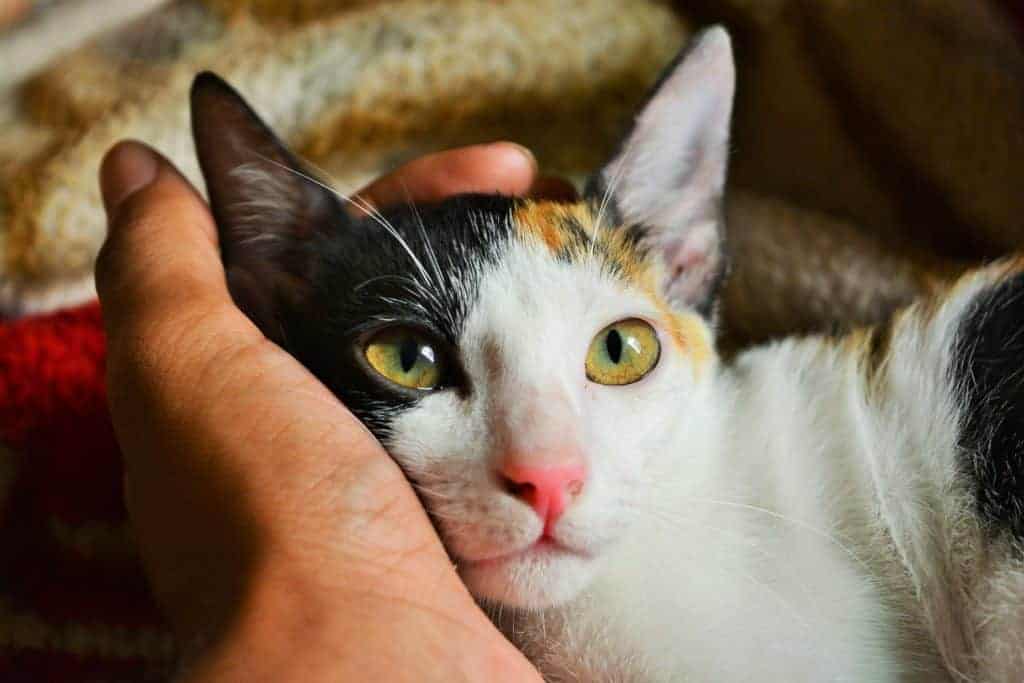
Cats show their love by purring, grooming you, showing you his belly, head butting you, and slow blinking to you.
Read more about cat communication in our post here.
Recognize Your Cat’s Face and Body Language
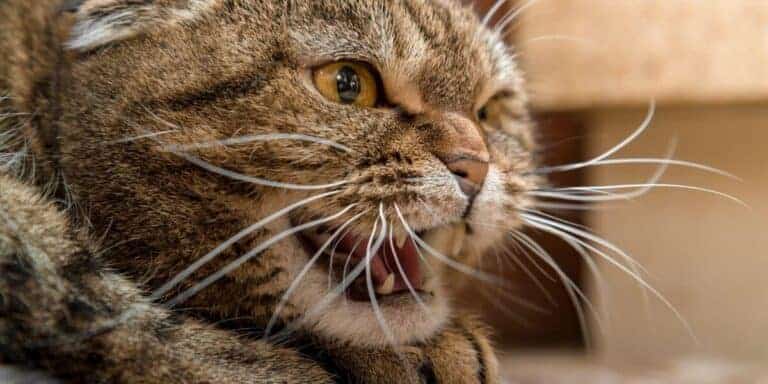
A study published in Animal Welfare says that cats “make facial expressions that clearly communicate how they’re feeling.” We can use that for feedback on how they are feeling, just like we do in our human conversations. But most of us just aren’t very good at it.
“Anyone who writes cats off as sort of moody or distant is probably underestimating them,” said Georgia Mason, the senior author of the study. “The point is they are signaling, it’s just subtle and you need expertise and maybe intuition to see it.”
The researchers showed 20 clips of cat videos. Ten had negative communication and ten were positive. People were asked to view the clips and categorize them. The average person scored 12 out of 20.
Are you a cat whisperer? Take an internet version of the quiz to see. Did you beat the average score of 12?
Thirteen percent of the study subjects performed at 15 or better. These “cat whisperers” tended to be women, and vets or vet techs. Pet owning status didn’t seem to make a difference. It seemed to be easier for people to identify the positive body language than the negative.
More understanding of cats’ body language and facial expressions will help us better understand our feline friends. The more we understand them, the better we can communicate with them and the more pleasing our relationship can become.
Tips For Bonding With Your Cat
How do cats choose their favorite people? It is all about respect, communication, and bonding. If you want to become your cat’s favorite person, you have to give him the respect he deserves.
Listen to what he’s telling you. Give him what he wants when you can.
Give him room when he wants it. Give him cuddles when he asks. Don’t force it. Think about what it’s like to have someone invade your personal space. In a cat’s world there is nothing worse than having snuggles forced upon you.
Play with your cat the way he likes. Brush him gently. Slow blink back to him. If you take the time to really get to know your cat and his signals, you’ll have no problem becoming his favorite person.
Conclusion
Your relationship with your cat is much more than a food provider and litter scooper. As in every relationship, it comes with compromise. Learn to speak his language, don’t expect him to learn yours.
Your cat becomes more social the more you understand him and engage with him in ways that he enjoys. You can become your cat’s favorite person if you put in the effort to understand how he shows his affection and get to know him the way you would any other friend.