
9 Health Mistakes Almost Every Multi-Cat Guardian Makes (and How to Fix Them)
Contents
Summary
Health Mistakes Almost Every Multi-Cat Guardian Makes usually aren't about "bad care", usually come down to crowding stress, missed pain behind conflict, too few or poorly placed litter boxes, dirty box routines, uneven parasite prevention, group feeding that hides weight changes, and not enough water and vet support. Cats also hide illness. The good news is that most of these mistakes are fixable without turning your house upside down. It requires small systems that protect the quiet cats as well as the bold ones.
Living with five or more cats can feel like running a small, fuzzy city and it can get overwhelming. When things run well, it’s cozy and calm. But when they don’t well… it can be anything but that. Cats are remarkably adaptable, but competition for territory and access to resources like food, water, litter boxes, and our attention can cause stress and discontent. This leads to illness and behavior problems. So in a busy home, systems matter more than good intentions.
That’s why the Health Mistakes Almost Every Multi-Cat Guardian Makes usually aren’t about “bad care.” They’re about missing the simple setup that protects everyone, especially shy cats and seniors.
The good news is that most of these mistakes are fixable without turning your house upside down.
The Mistakes Almost Every Multi-Cat Guardian Makes That Cause Cats Stress:
Stress in cats isn’t just “acting out.” It can change appetite, sleep, grooming, and litter box habits. It can also cause flare-ups of respiratory problems, or urinary issues and digestive distress.
In multi-cat homes, stress often comes from the same root: competition and lack of control. If a cat can’t reach food, water, a litter box, or a favorite nap spot without passing a gatekeeper cat, their body stays on alert. Over time, that strain shows up as weight loss, constipation, over-grooming, or sudden hiding.
It’s important that we provide enough resources to our kitty city. The more cats, the more we need to provide. The general rule of thumb is as many of each resource as you have cats, plus one, spread out through your house in separate locations.
Health mistake #1: Not giving enough safe space and vertical space
More cats need more territory, not just more affection. Floor space helps, but cats like to be up high to survey their territory. Cats have evolved to hunt from high vantage points so vertical space is often the real pressure relief valve. Think of it like adding extra lanes to a freeway. Cats can pass each other without conflict and work out their own “time-share” arrangements. Being up high allows cats to feel secure and in control of their surroundings, which can help reduce stress and anxiety.
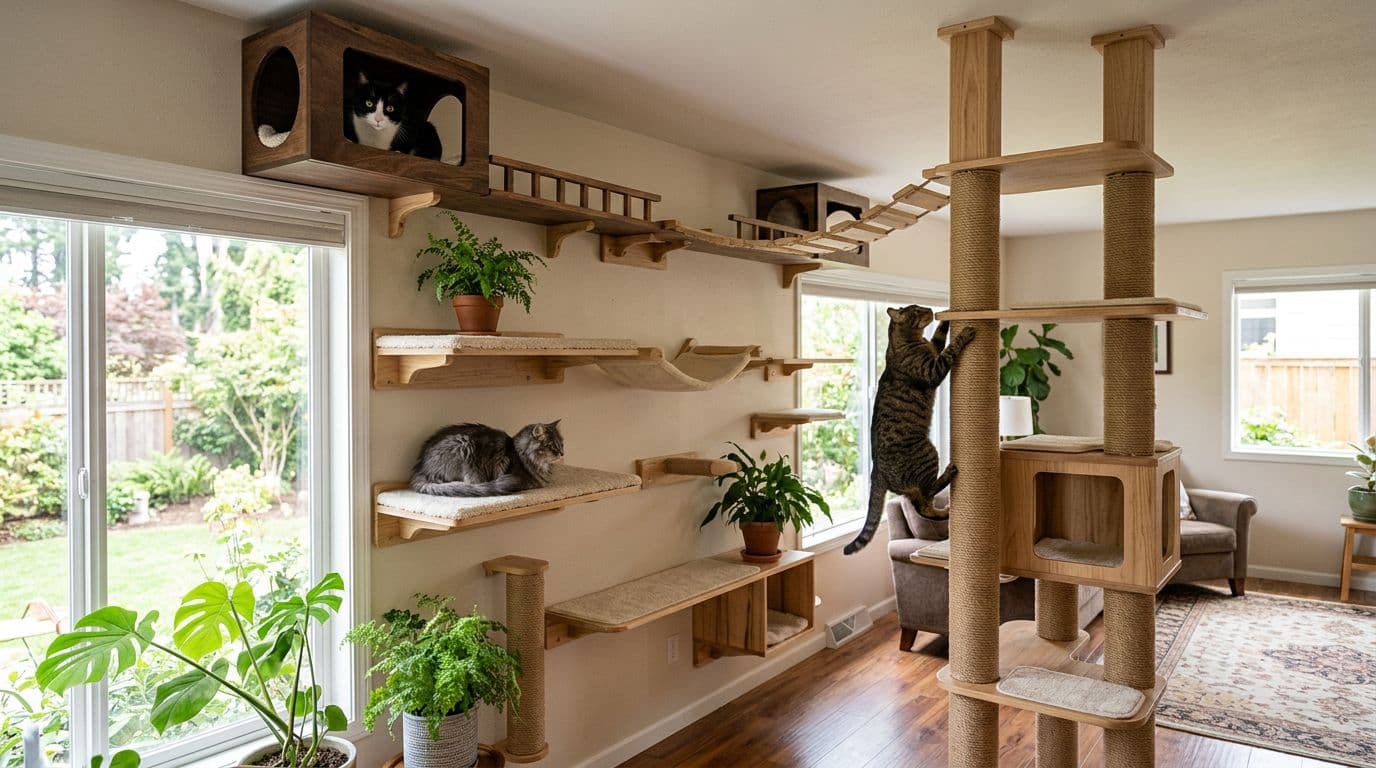 Three cats share vertical territory on trees and wall shelves, which reduces crowding and tension (created with AI).
A few practical upgrades that usually make a big difference:
- Add tall cat trees and sturdy shelves in more than one room.
- Create separate resting zones, not one “cat pile” spot.
- Offer both covered and uncovered hiding options.
- Keep at least one quiet room that stays calm, lights low, traffic minimal.
- Make sure there are multiple entry and exit routes, so one cat can’t trap another in a hallway or doorway.
Related Post: 5 Reasons Your Cat Needs Vertical Space
Conflict between cats is usually a sign that something in the environment needs changing. Cats don’t typically “work it out on their own.” Also, don’t write off constant hiding as “that’s just her personality.” A cat who always stays tucked away may be stressed, in pain, or being bullied.
If your home only has one “safe” area, the bold cats will control it.
Health mistake #3: Assuming fighting and bullying is normal, so you miss the medical causes
Some friction happens, but if you see a sudden shift in aggressive behavior or bullying is a health clue. Pain often makes cats irritable. Dental disease, arthritis, urinary discomfort, and thyroid problems can all shorten a cat’s fuse.
Instead of labeling a cat as the “mean one,” watch for patterns that point to a body problem:
- Sudden swatting or growling during normal touch
- Guarding doors, stairs, or narrow paths
- Blocking food or chasing others away from bowls
- One cat losing weight, or a fast eater gaining
- Over-grooming, especially belly or legs
- Peeing outside the box, or frequent box trips with little output
Veterinary teams are also moving away from simple “aggression” labels and focusing on the full household dynamic. A helpful reference is Clinician’s Brief guidance on intercat behavior in multi-cat homes (registration is required but it’s free.) Most importantly, schedule a vet exam to rule out anything medical before you start coming up with behavior modification plans.
Mistakes around litter boxes and hygiene that can snowball into urinary and parasite issues
In a large multi-cat home the litter box issue can become a point of contention; not only among the cats but for the people involved. More cats = more boxes = more work to keep them maintained. It’s tempting to get a couple big boxes or a robotic litter box and expect the cats to do what we want. Appropriate litter boxes and their maintenance is one of the biggest mistakes almost every multi-cat guardian makes.
One reason litter boxes are so important is that for the cats, litter boxes are more than toilets. They’re part bathroom, part communication board, and part safety issue. When the setup isn’t right, you don’t just get mess. You get stress, avoidance, and urinary flare-ups.
The same “group living” effect applies to parasites. If fleas, worms, or mites show up, they rarely stay limited to one cat. That’s why the clean-up plan has to be simple enough to repeat, even on busy weeks.
Health mistake #4: Too few litter boxes, or boxes placed in the wrong spots
The plain-language rule: one box per cat, plus one extra. With five cats, aim for six boxes. That extra box matters because it reduces waiting, guarding, and ambushes.
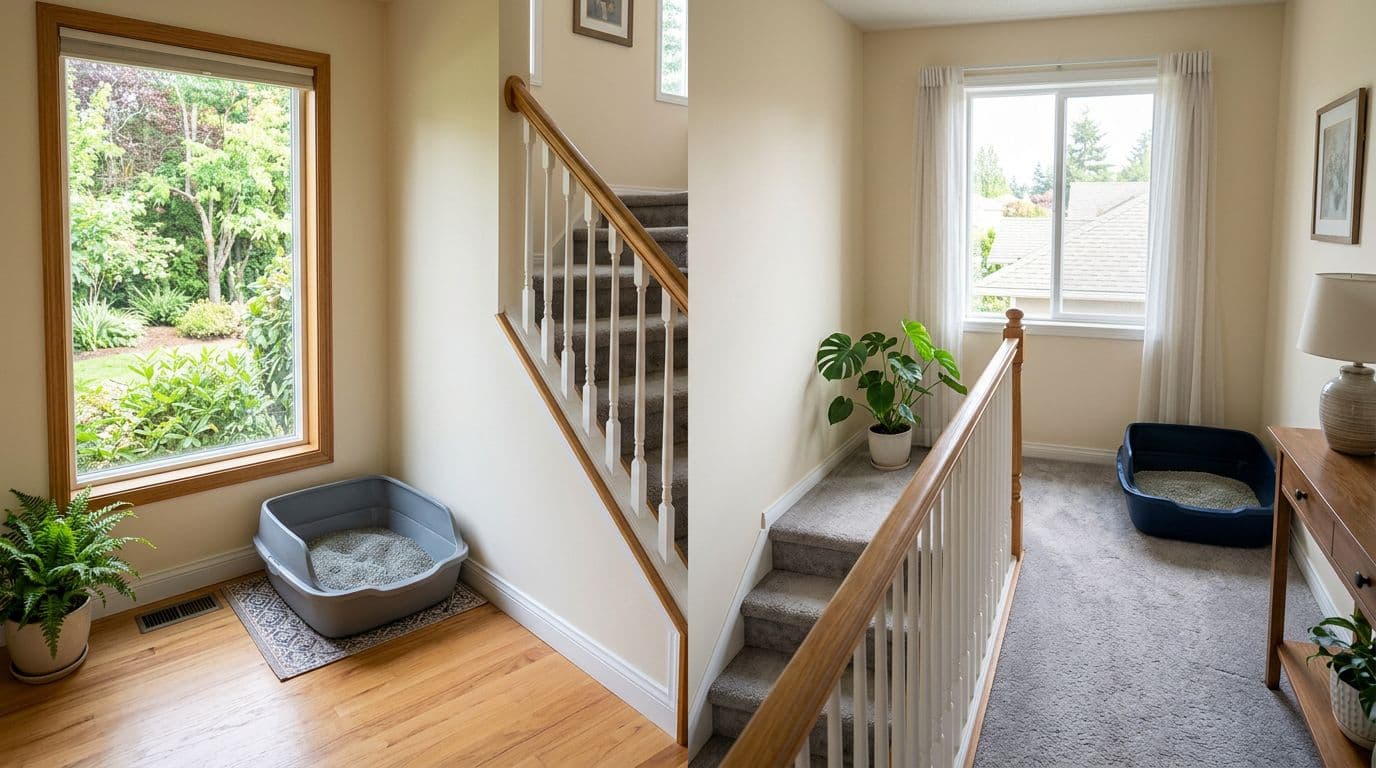 Litter boxes spread across quiet areas help cats avoid conflict and keep routines steady (created with AI).
Placement matters as much as the count. One “litter room” can turn into a choke point, especially if a confident cat camps near the door. Spread boxes out, keep them quiet, and place at least one on each level of the home.
Size matters too. Many cats do better with large, open boxes that let them turn around easily. For deeper tips on making boxes feel safe, see Ohio State’s litter box guidance.
Health mistake#5: Letting litter box cleanliness slide, then blaming the cat
When boxes get dirty, some cats hold it. Others go elsewhere. Either way, the stress goes up, and urinary trouble can follow. It’s important to keep an eye on everyone’s “output” so you notice changes. Pay attention to who uses what box the most.
A realistic baseline routine looks like this: scoop at least once or twice daily, do a full wash weekly, and replace worn plastic boxes on a regular cycle (scratches hold odor) or get metal boxes. Strong smelling cleaners and heavily scented litter or additives can backfire, especially with sensitive cats. If a cat refuses the box after a change, roll back to the last setup they used reliably.
Caregiver burnout happens and litter boxes are one big reason why. So build a backup plan before you need it. Put out an “emergency box” for chaotic weeks, or hire a pet sitter to maintain normal upkeep.
Health mistake #6: Inconsistent parasite prevention and home cleaning in a group setting
Tempting though it may be to save money by only treating only one or two cats that have greater risk, it usually fails. Fleas reproduce in the home, and some intestinal parasites spread through shared spaces. In a crowded household, it’s best to talk with your vet about a whole-group plan so everyone is protected on the same schedule.
Watch for early clues because I can attest to the fact that a flea infestation in a large multi-cat household is a real nightmare. Look for frequent scratching, scabs near the neck, flea dirt when you comb, or rice-like tapeworm segments near the tail. Never use dog-only parasite products on cats. Some are toxic, even in small amounts.
Related Post: Don’t Let a Flea Treatment Kill Your Cat
Mistakes with food, water, and vet care that make illness easy to miss
Health problems often hide in plain sight in a multi-cat household. One cat eats too much, another eats too little, and their guardian only sees “everyone showed up.” One gets fat. One starts losing weight. One has a digestive problem. Add a few skipped checkups because transport or the finances feel impossible, and small issues grow legs. Dental problems or thyroid conditions are confused with bullying or guarding or not liking the food offered. Food allergies can be confused with hairballs.
The fix is not perfection. It’s a few repeatable routines that make change visible.
Health mistake #7: Group feeding that hides weight loss, overeating, or food theft
“Everyone eats” is not the same as “everyone eats enough.” Shy cats often step back first. Seniors also lose out when they can’t compete, even if they want to. One cat may get bullied out of her dinner by a housemate she doesn’t get along with. So what do we do?
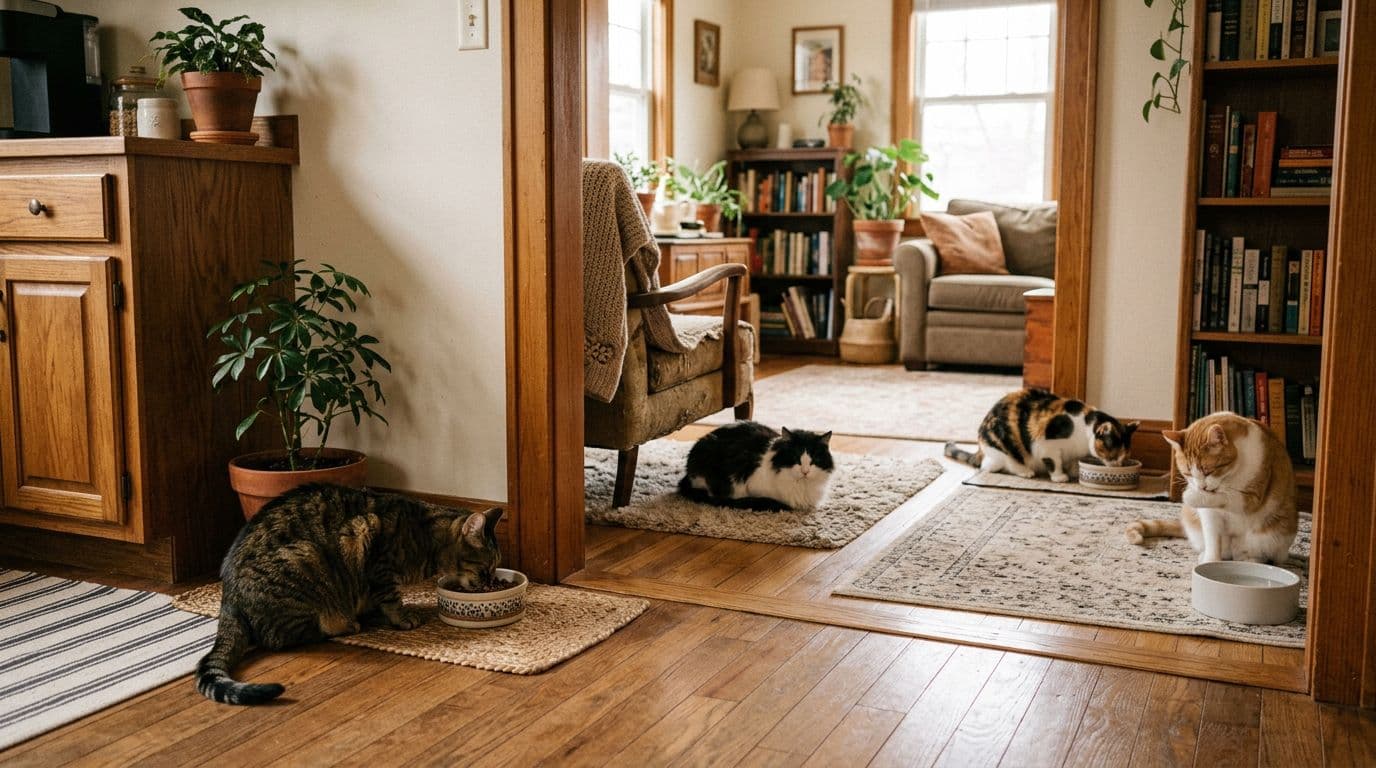 Separate feeding stations make it easier to spot who’s eating well and who’s being pushed out (created with AI).
Try separate feeding stations in different rooms, or feed in calm “pods” with closed doors for 10 minutes. Timed meals help too because they limit grazing and make intake easier to notice. If you can swing it, microchip feeders can reduce food theft, make it easier to allow a senior, an underweight cat, a kitten, or someone with a special diet access to food the others don’t eat. Don’t rely 100% on technology without supervision though. Some cats are smart enough to beat the system as we learned the hard way.
Cage feeding works well for households managing multiple dietary needs. Putting everyone in their cages to feed the multiple small meals a day cats thrive on is certainly more work than leaving out one big bowl of kibble with free access but it allows for better monitoring and management of potential problems.
A quick weekly weigh-in also catches problems early. Use a baby scale for smaller cats, or the bathroom scale method (you alone, then you holding the cat) if you’ve got a larger cat or don’t want to invest in a scale just for the cats.
Health mistake #8: Too few water stations, or only dry food, leading to dehydration risk
Dehydration can stack the deck toward constipation and urinary issues. Some cats also avoid water if it’s near litter, in a loud hallway, or guarded by another cat. The resource guarding problem is something that does often crop up in multiple cat households. Use the same “number of cats plus one” idea that we do for litter boxes for water spots.
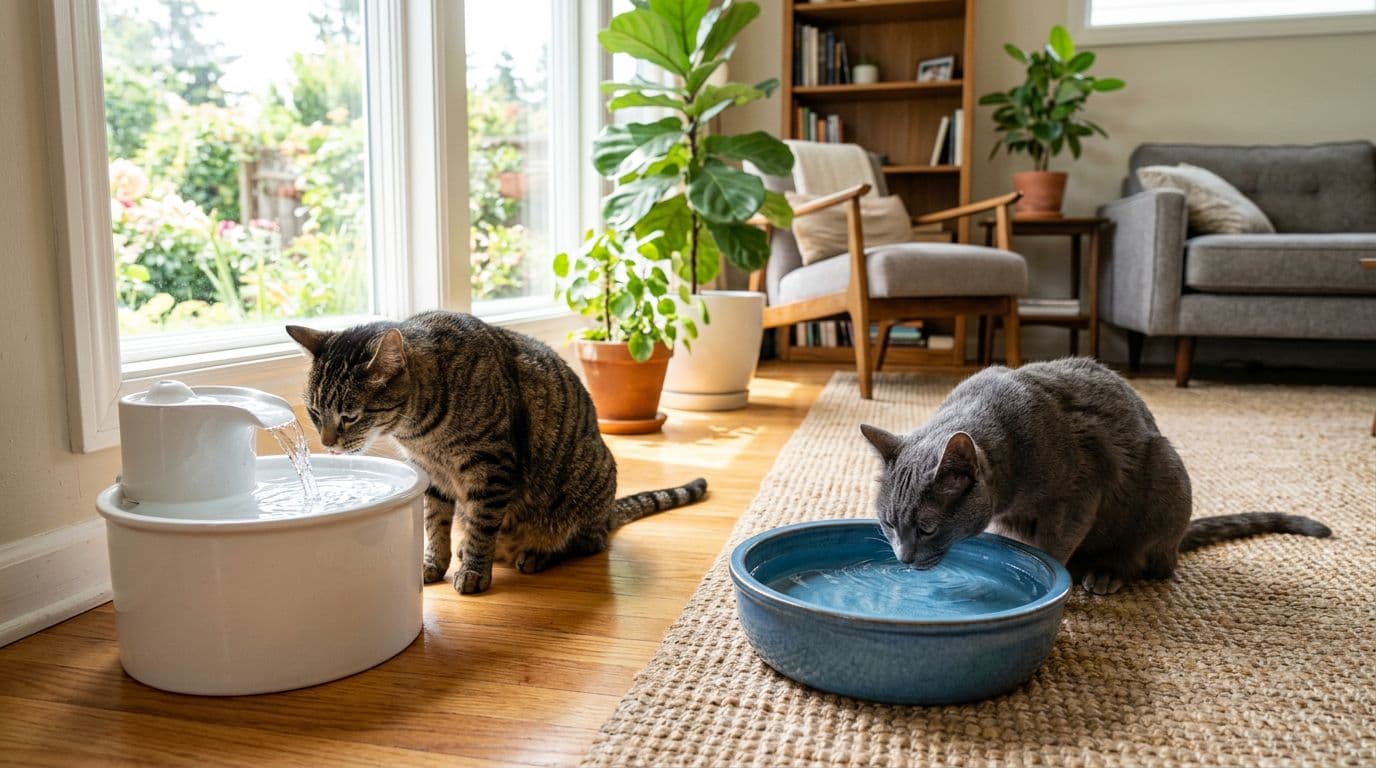 Two cats drink comfortably from a fountain and wide bowls placed in calm, accessible spots (created with AI).
Fountains may help attract cats to drink more but give you something else to maintain. Wide bowls can reduce whisker stress.
Including wet food a few times can help hydration. Some guardians add water to wet food, or use vet-approved broth, as long as it fits the cat’s diet needs.
Health mistake #9: Skipping routine checkups because getting 5+ cats to the vet feels impossible
Transport logistics stop a lot of good guardians from accessing vet care for their cats. Cats hate their carriers or the car. The financial burden is difficult. Still, routine care is how you catch dental disease, kidney changes, and weight trends before they explode. Logistics can become even more challenging the more cats we have.
Make it doable with a system: stagger visits, keep carriers out as normal furniture, and maintain a shared health log. At home, do a quick weekly scan during a calm moment:
- Eyes and nose (clear, no discharge)
- Gums (pink, not angry red)
- Coat (no new dandruff, bald spots, or heavy matting)
- Breathing at rest (steady, not strained)
- Litter box output (pee volume, poop frequency, anything off-pattern)
If you would like a printable checklist to follow during these weekly check, click here to download.
Cats hide pain well, so “nothing seems wrong” isn’t a health plan.
Twice-yearly checkups can be especially useful for seniors or cats with chronic issues. Even one scheduled visit this month can reset the whole household.

Conclusion
The 9 Health Mistakes Almost Every Multi-Cat Guardian Makes usually come down to crowding stress, missed pain and disease, bullying, too few or poorly placed litter boxes, dirty box routines, uneven parasite prevention, group feeding that hides weight changes, and not enough water and vet support. None of this requires a perfect guardian, it requires small systems that protect the quiet cats as well as the bold ones. Pick one change to do this week, add a litter box, add a water station, separate meals, or schedule one vet visit. Your future self (and every cat in the house) will feel the difference, especially the ones who never complain.