

Complete Guide to Proper Cat Dental Care
Contents
- 1 Summary
- 2 Signs of Dental Disease in Cats
- 3 How to Check Kitty’s Teeth and Gums
- 4 What to Expect from a Veterinary Dental Cleaning
- 5 Types of Dental Disease in Cats
- 6 How to Brush a Cat’s Teeth for Better Cat Dental Care
- 7 Alternatives to Brushing a Cat’s Teeth:
- 8 Summary of Cat Dental Care:
- 9 For more in my grooming guides series:
Summary
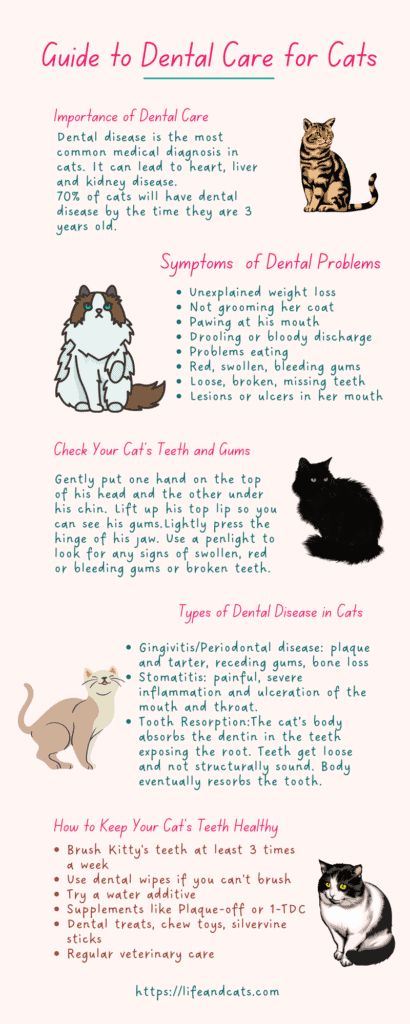
Most cats will experience dental disease at some point in their lives. Poor dental health causes cats severe pain and affects their overall health. It is relatively easy to take care of your kitty’s teeth at home through a dental hygiene program of brushing and supplements with regular vet care and a good diet.
Last Updated on February 20, 2026 by Holly Anne Dustin
A proper at-home cat dental care routine for your cat, along with annual vet checks, is vital for her overall health. It’s important to regularly check the state of your cat’s teeth and gums. Kitty can’t tell you that she has a toothache and her gums are bleeding. She’s counting on you to protect her oral health.
The American Veterinary Dental Society estimates that 70% of cats will have dental disease by the time they are 3 years old. Cats are masters of hiding pain. Unless you are looking for it, you won’t notice there’s a problem until she stops eating, loses weight, or has foul smelling breath.
Dental disease is the most common medical diagnosis in cats. It can lead to heart, liver and kidney disease. Problems with dental health make regulating a diabetic cat much more difficult. Providing proper dental care for your cat will improve her overall health and well-being.
Want to learn more about a cat’s teeth? My friend Sierra has written about the types and composition of cats teeth at Fur Everywhere.
Signs of Dental Disease in Cats
You might notice the following symptoms if Kitty has developed dental disease:
- Bad breath
- Unexplained weight loss
- Not grooming her coat
- Pawing at his mouth
- Drooling
- Problems eating
- Red, swollen, bleeding gums
- Loose, broken, missing teeth
- Bloody discharge
- Ulcers in her mouth
If you notice any of these symptoms do a check on his teeth and gums.
Does Kitty have bad breath? Click here to learn more about causes and treatments.
How to Check Kitty’s Teeth and Gums
Gently put one hand on the top of his head and the other under his chin. Lift up his top lip so you can see his gums. Some cats will just let you do it. Others will keep their mouth firmly closed.
A light squeeze on the hinge of his jaw should encourage him to open his mouth for you to get a quick peek at least. With practice and good treats they eventually get used to it.
Kitty’s teeth should be clean and white, with no chipping. His gums should be pink and healthy. If his mouth looks red or inflamed and his breath is worse than usual, then it is time to take Kitty to the veterinary dentist for some professional cat dental care.
What to Expect from a Veterinary Dental Cleaning
Proper cat dental care at your vet’s office consists of an oral exam and x-rays under anesthesia in order to diagnose any dental disease present under the gum line. Then the teeth are scaled and polished, similar to how the dentist cleans your teeth. Any teeth that need to be removed are extracted. A thorough dental without extractions usually takes about an hour and costs between $100 and $400 depending on where you live, your kitty’s age, any underlying conditions. Adding necessary extractions will increase the price significantly.
Types of Dental Disease in Cats
Periodontal Disease
Like in humans, dental, or periodontal disease starts with plaque and tartar building up on the teeth. If the plaque isn’t removed before the tartar builds up it will lead to gingivitis, the inflammation of the gums, and the separation of the gums from the teeth. This can lead to bone loss, infections, and abscesses.
As the disease advances to periodontal disease, the gums recede and expose the roots of the teeth. Gingivitis is common in cats. More severe disease is often a problem for cats that have diseases such as feline leukemia, FIV, calicivirus, kidney disease, diabetes, or autoimmune diseases.

Stomatitis
Stomatitis is a severe inflammation of the mouth. It can cause ulceration of the mouth and throat. It is extremely painful.
Your cat may not eat, or may paw at her mouth. You’ll see her take a bite of food and drop it, or run away from the bowl. She may try to eat and cry out in pain. She may not groom her fur. Her mouth and throat will be red, sore, and inflamed. I’ve been through this with Treeno and it was no fun at all for either of us.
Sadly, stomatitis can affect cats of any age, even young kittens. It appears to be an autoimmune disease where the body attacks itself because of the plaque bacteria in the mouth. A recent study shows that a calicivirus may provoke the cat’s immune system into overdrive. Persian breeds appear to be prone to stomatitis but it can affect any breed of cat.
Treatment involves pain relief, steroids, and antibiotics to treat the infection. Cats with stomatitis need regular dental work and extensive at-home dental care. They are likely to need some, if not all, their teeth removed.
Removing the majority of a cat’s teeth solves the problem in about 80% of cases. In others the cat will still need long-term anti-inflammatory and antibiotic treatment.
Tooth Resorption (FORL)
FORL is a common and under diagnosed condition. It affects 30-70% of cats over age 5. The cat’s body absorbs the dentin in the teeth exposing the root. It usually shows on the outside of the tooth. It might look like a “cavity” (actual cavities are rare in cats) or the gums may appear to be growing over the tooth. By the time you notice the symptoms there will be significant damage because the resorption starts inside the tooth and works out.
There are 5 stages to the disease:
- Mild, a slight defect in the tooth enamel, no pain to the cat because the damage hasn’t affected the nerve.
- Moderate hard tissue loss but still has not reached the pulp cavity.
- Hard tissue damage that reaches the pulp cavity, but the tooth remains viable.
- Extensive damage and the tooth is not structurally sound or viable
- The tooth is resorbed, a bump in the gum is all that remains.
Like stomatitis, the only treatment is extraction. It is important that your veterinary dentist uses x-rays at the time of extraction if your cat has FORL and/or stomatitis. The surgeon will need to make sure he or she gets all the fragments of tooth material out from under the gums or the cat’s body will keep attacking the remaining fragments and the disease will not resolve.
People blame cats diet for the development of tooth resorption, but FORL seems to have been around as long as cats have. There are remains of cats from 800 years ago that show signs of tooth resorption. It is more likely viruses and autoimmune functions lead to development of FORL.
Statistically, in modern days, more cats with FORL are older, female, have been on medication, drink city water as opposed to well water or bottled water, and play less with toys. At-home dental care at least twice a week seems to make a significant difference.
How to Brush a Cat’s Teeth for Better Cat Dental Care
This post may contain affiliate links. Life and Cats is a Chewy affiliate and a member of the Amazon Associates program and as such we earn a small commission when you shop through our our links and banners. It doesn’t change the amount you pay. You can read our full disclosure policy here.
Brush her teeth. Yes, really. It will become part of your daily grooming routine. Like all aspects of the grooming process, it will be easier if you start young. But even adult cats can get used to the process of having their teeth brushed.
You will need toothpaste designed for cats and a toothbrush small enough for your cat’s mouth. You can get one designed for pets, a small baby toothbrush, or a finger cap brush. Personally I only have had success with the smallest pet brush on the market.
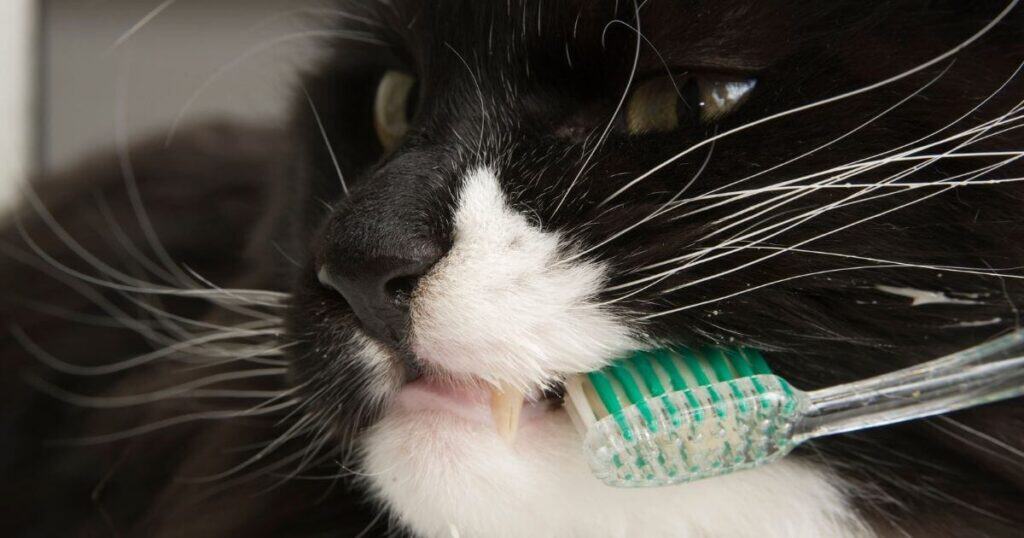
Cornell recommends a 4 week process to get your furbaby used to having his teeth brushed. (Video here)
- Week 1: Let Kitty get used to the flavor of the toothpaste. Make it a treat. No brushing involved. Just make it a pleasurable experience. Let him see and explore the brush but do nothing with it. Offer him the toothpaste. If he licks it, reward him. If he’s resistant, you can put a little on his paw or near his mouth where he will lick it off.
- Week 2: Put the paste on one of his canine teeth (fangs) with your finger or gauze. He’ll swish it around with his tongue.
- Week 3: Introduce the brush, continue just putting paste in his mouth but with the brush.
- Week 4: Brush his teeth. Don’t make it stressful, don’t worry about scrubbing. Aim for the crevice where tooth meets gum and get front and back. Don’t worry about the inside the teeth, Kitty’s tongue and the paste will clean the teeth.
Click on this link to learn more about brushing Kitty’s teeth.
Alternatives to Brushing a Cat’s Teeth:
There are other products on the market to supplement brushing.
- Water additives or rinses: Vary in effectiveness. Chlorhexidine is the most effective but cats may not respond positively to the taste. My cats have had good results with the Tropiclean line.
- Plaque-off: Kelp-based powder to add to food. Controversial because kelp contains iodine, but I have had great success with Plaque-Off.
- 1TDC: A supplement that supports Kitty’s oral health and more. Vet formulated. Treeno loves it and I believe it is helping heal his mouth. 1T:DC also supports cats with arthritis.
- Toys: Petstages makes a line of dental toys covered with a mesh type fabric they market to help scrape plaque off a cat‘s teeth as he plays.
- Treats: There are lots of options for treats if your cat can crunch or chew. Look in the dog chew aisle for things like turkey tendons or rabbit ears. Sounds gross but a lot of cats love them as much as their canine friends. Other options are kibble-style treats like Dentalife, CVet, or Greenies. You can even use small amounts of a vet prescription diet as treats.

Summary of Cat Dental Care:
Most cats will experience dental disease at some point in their lives. The major problems in cat dental care are stomatitis, resorbtion (FORL), gingivitis and periodontal disease. Poor dental health causes cats severe pain and affects their overall health. It is relatively easy to take care of your kitty’s teeth at home through a dental hygiene program of brushing and supplements with regular vet care and a good diet.
Sources:
Gum Disease in Cats
8 Common Dental Problems in Cats
Teeth Resorbtion
Feline Stomatitis
Feline Dental Disease
For more in my grooming guides series:
Skin and Coat
Eye Care
Paws and Claws
Ear Care