
Choosing Safe Cat Toys in an Unregulated Market
Last Updated on July 30, 2021 by Holly Anne Dustin
I’m sure we’ve all seen the news story about the woman that sued Petco because her kitty hurt her eye on a toy tunnel. It prompted me to do some thinking and research about choosing safe cat toys.
I worked in pet retail management for an independent retailer for 7 years. I’ve stocked and sold a lot of toys! We got safety complaints about dog toys a lot more than cat toys. The usual complaint with cat toys was that the customer’s cats didn’t like the toy.
But there are some legitimate safety concerns over cat toys too. Some have small parts. The decorations on others aren’t firmly attached. And in other cases, the manufacturer didn’t think of all the trouble cats, especially kittens, can get into. We have to do some work to make sure the toys we buy our furbabies are safe.
Contents
No One Regulates Cat Toys
Pet toys are not regulated by the Consumer Product Safety Commission. The government doesn’t consider them consumer products because they aren’t for humans. The only way regulators can inspect cat toys is a potential harm to a human.
Kids’ toys are protected under the federal toy safety standard, ASTM F963-11. Products used by children under age 12 need to be tested for lead, hazardous materials, and flammability by a third party. Not so our furkids toys.
But even childrens’ toys have an element of common sense involved. They have an age range on the packaging and a “small piece” warning on anything that a baby could swallow. It is still on you to make sure a toy is safe and appropriate for your child.
Likewise, we have to consider whether a particular toy is appropriate for our furbaby. Strings, yarn, ribbons, mylar, bells, feathers, decorations, and small pieces all have the potential to be dangerous. But not all would pose an immediate danger to all cats. The same toy might be perfectly fine for Plush, but completely unsuitable if I gave it to Mocha. She’s a chewer and hard on her toys, he’s placid and doesn’t destroy his toys.
So What’s a Pet Parent to Do?
Play is a critical part of keeping a cat healthy, fit and mentally sharp. It prevents obesity, boredom, and behavior problems. Play gives an indoor cat a way to exercise his natural hunting instinct. Plus it’s just fun. Watch Kitty stalk, chase, and hunt his toys. You’ll see how much fun he’s having engaging with his inner predator.
Choosing safe cat toys isn’t impossible. It just takes some research and some understanding of the way your cat plays.
Think about how your cat plays with his toys
- Generally speaking, cats play rough.
- Who is going to be playing with it? Kitten, cat, senior, multiple cats.
- How do they play? Are they very aggressive with their toys, or do they like to carry them around and baby them?
- Do they chew or tear up a certain kind of toy?
- Are they flyers, jumpers or four-on-the-floor stalker cats?
- Are you looking for a toy they can play with alone or with you?
This post may contain affiliate links. Life and Cats is a Chewy affiliate and a member of the Amazon Associates program and as such we earn a small commission when you shop through our our links and banners. It doesn’t change the amount you pay. You can read our full disclosure policy here.
Read reviews of products online
I don’t pay a lot of attention to the “my cat didn’t like it” reviews, but safety concerns do pop up as well. Compare the products while you shop. You can often find a reasonable substitution that is safer.
For example, this 3-way ball track toy. As you see in the reviews, cats get their head stuck in the large open center. Petstages makes a similar toy and we heard the same stories from customers. They have now redesigned the toy to have a bar across the center area. Or you can get this one, where that center area is completely covered.
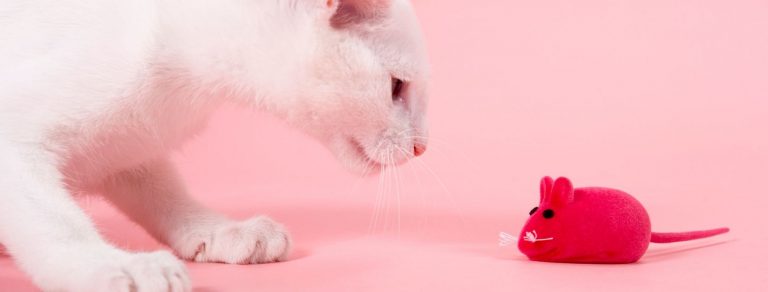
Or catnip mice. There are the real rabbit fur models that most cats adore; but they have little plastic eyes and noses that are tacked in. It could cause injury to the mouth, throat or internal organs if your cat pulls the tacks out or swallows them. Either pull the eyes and nose off before giving them to your cat or go with something where the eyes are sewn on.
As for tunnels, when I searched Petco’s site it returned 19 tunnels. None of them looked so particularly poorly made as to have caused the injury described in the news story. They had fleece covered fabric ones (seems hard to clean), crinkly ones with dangly toys inside (I’d cut the toy off and let them play with it separately), crinkly ones with lights (I wouldn’t get that, risk with batteries and light bulbs), and even one with Jackson Galaxy’s name on it that is made out of mesh. I wouldn’t get that one either, it seems like there’s a high risk of Kitty getting his claws caught in the mesh. My favorite tunnel is just a plain crinkle tunnel (cut the pompom off).
What to Look for When Purchasing a Cat Toy:
Safety, durability, and playability are all important factors when choosing a toy for your kitty. You’ll be able to choose a toy Kitty will actually play with once you’ve observed how she likes to play.
I ask these questions about safety and durability:
- Is the toy the right size for the cat? Can she pick it up in her mouth and not swallow it?
- Is the toy sturdy enough when bitten, bunny kicked and generally mauled?
- Is it strong enough to hold your cat if it is something he should climb?
- Are the pieces attached securely and safely? Sewn, not glued or tacked.
- Are there sharp edges or things protruding from the toy?
- Could Kitty get caught in strings or handles? I heard a horror story of a kitten getting tangled in a string on a cat tree and falling, with fatal results.
- What fills the toy? Fluff and catnip? Or dangerous polystyrene beads?
- Can Kitty possibly get his head or a paw stuck in the toy? Caught by moving parts?
- Is the toy appropriate for the way your cat plays?
Adapt the Toys to Make Them Safer
I know it seems like we really shouldn’t have to “fix” toys to make them safe. But it is our job to keep our babies safe. Sometimes it is better to compromise by adapting a toy with high playability. After all, choosing safe cat toys does no good if Kitty ignores the toy.
Here is my basic safety list:
- Remove any bells, glued on decor, or tacked-in eyes and ears that could easily come loose, be swallowed or injure your cat.
- Cut off feathers and strings from solo play toys because I know Treeno will eat them (might not apply to your cat.)
- Cut off toys that dangle from cat trees or inside of tunnels or runners.
- Don’t use mobiles or other self play toys with strings or moving pieces unsupervised.
- Keep wand toys out of reach when you aren’t playing. Put them in a drawer or a closet that you know Kitty can’t get in. Mocha saw me put her favorite wand toy on top of a 7-foot bookshelf, behind a carrier, and devised a way to get up there and get it down.
- Make sure cat wheels and mechanized toys don’t have room for Kitty to stick their paws or head under or in the mechanism. This is especially important in multiple cat situations.
Related Post: Importance of Play for Your Cat
Supervise and Inspect
The most important safety step we can take is regularly inspecting Kitty’s toys to make sure they aren’t wearing out. Rattan toys can fray into sharp pieces, sisal toys can unwind, mylar can tear into sharp pieces, and yes, fabric stress can uncover wire or other fittings.
Finally, if you’ve done your due diligence and chosen the best toys for your cats, and you’ve inspected them to make sure they are still safe, have a great time playing with your cat. Play is critical to her physical and mental health. It will be a lot of fun for you too!