The Mythical Norwegian Forest Cat: Your New Best Friend
Last Updated on January 13, 2026 by Holly Anne Dustin
Contents
Norwegian Forest Cat Facts
Norse mythology speaks of a cat so large even Thor couldn’t lift it. Freya, the goddess of Love, had a carriage pulled by two of the large cats. Norse fairy tales mention troll cats who were huge and furry. Over time the troll cat became just Skogkatt, meaning Forest Cat. The first Norwegian Forest Cat Club was formed in Norway in 1938 for the purpose of protecting the breed.
Norwegian Forest Cats are a natural bred cat. They traveled with the Vikings to control mice aboard ship. They may have landed in the New World with Leif Ericson and become the ancestor to the Maine Coon.
The breed was almost lost due to breeding with random bred cats. The Norwegian Forest Cat Society rescued them after World War 2. The first breeding pair came to the US in 1979. The International Cat Association (TICA) recognized the Norwegian Forest Cat, popularly known as “Wegies” in the US, for championship status in 1984. The Cat Fanciers Association (CFA) accepted them in 1993.

Characteristics of the Norwegian Forest Cat
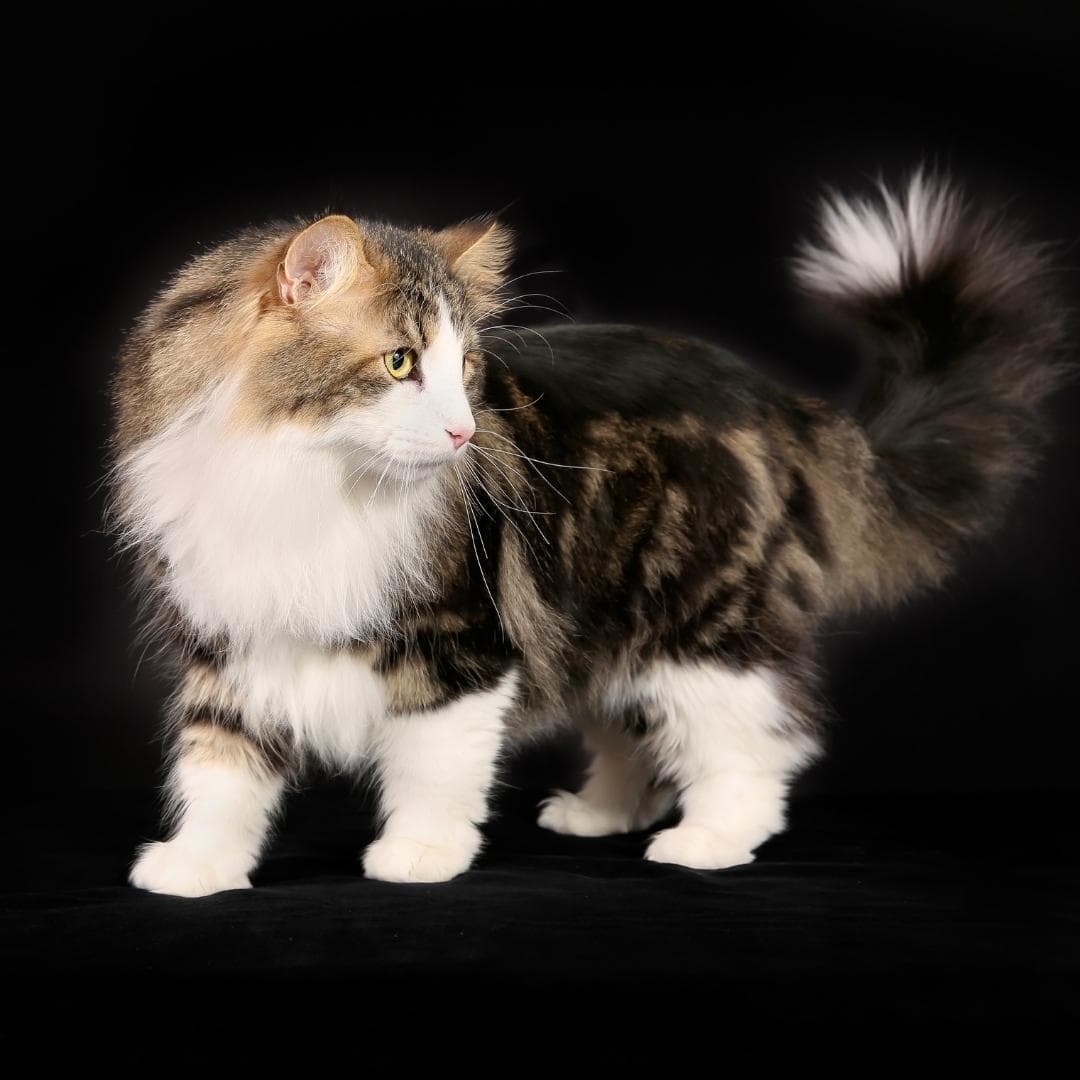
- The NFC comes in all colors and patterns except color pointed, and the chocolate and lilac colors. The brown tabby with white is most common.
- The Wegie’s average size is 12-15 pounds for a male and 10 pounds for females but it isn’t unusual for the males to reach 20 pounds. They are a medium to large cat and don’t fully mature until they are around 5 years old.
- The head should be an equilateral triangle from the firm chin to the base of the ears. The profile should be straight with a roman nose. There shouldn’t be a break in the nose line.
- The Norwegian Forest Cat has medium to large ears; rounded at the tip and broad at the base. The ears should complete the triangle shape of the head. They should be heavily furnished. Lynx tips are desirable.
- All standard eye colors are accepted in Wegies, including odd eyed on whites. Green is the most common color. The eyes should be wide, almond-shaped and set at a slight angle.
- Norwegians are sturdy, rectangular shape cats. The rump is slightly higher than the shoulders because the NFC’s back legs should be slightly longer than the front. They need strong boning, even in kittens.
- NFC’s have a dense, double, water-resistant coat. Wegies are a semi-longhaired breed. The undercoat is wooly, the guard hairs are long. Tabby coats are denser than the solids, bi-colors, and tri-colors. They have full britches, a long bushy tail that should reach to the shoulders when pulled around and a full ruff. The ruff has 3 sections, a short back ruff, side mutton chops, and a full bib. Their paws are heavily tufted.
- Kittens have a wooly coat which changes when they are around 3 months old. They may look short haired until the long guard hairs start to grow in around 5 months old.
- The Cat Fanciers’ Association breed page for Norwegian Forest Cats is here.
Differences Between Forest Cats
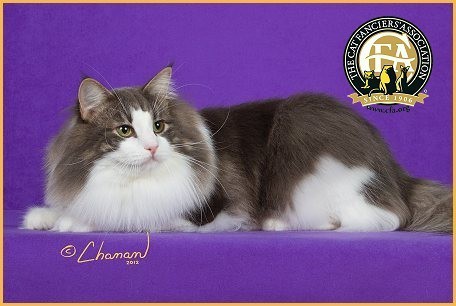
NFC’s are often confused with Maine Coons. While they are similar in size and stature there are significant differences among the two breeds as well as the Siberian Forest Cat. The most striking difference is the shape of the head. The Maine Coon head is square where the Norwegian is triangular. The Siberian has a rounded appearance.
The Siberian has a triple coat. The Maine Coons and Norwegians both have double coats. The Maine Coon has a shag coat and Wegie is fluffier.

Grooming Your Wegie
Despite their beautiful long coat, Norwegian Forest Cats don’t need a lot of grooming. Keep their nails trimmed and their ears clean and a weekly combing should be enough unless they are going to a show.
Wegies molt out their undercoat in the spring. Some cats may even look short-haired for a time when they molt. They will grow the undercoat back in the fall. You will need to brush your NFC 2-3 times a week while they are molting.
Living with a Norwegian Forest Cat
Norwegian Forest Cats make great family pets. They are laid back cats, sensitive and social. Easily adaptable, they are great with kids and usually get along with other animals. They have a great personality, love life and everyone in it.
Your NFC will be your best friend. They don’t like being left alone. They’ll stay with you, involve themselves in whatever you’re doing and check in repeatedly.
Wegies are talkative, sweet and affectionate, but not loud like an Oriental. They are full of chirps and purrs.
These cats are natural athletes. Norwegian Forest Cats are great climbers. Their thick claws and strong legs allow them to climb down trees head first. They are very playful.
You’ll need to provide high spaces, things to climb, tall sturdy scratching posts, and plenty of playtimes to keep a Norwegian happy. If you are looking for a cat that will stay off the counters you might want to look at a different breed.
Health Issues Common to NFCs.
Norwegian Forest Cats are a relatively healthy, natural breed of cat. Typical lifespan is around 15 years.
There are 3 genetic health issues that affect Norwegian Forest Cats. When purchasing a purebred NFC, you should make sure the breeder has tested for these diseases and has documentation. Ideally, you should see generations of results. You should continue to test your own cat as well.
- Hypertrophic cardiomyopathy is the most common form of heart disease in cats. It causes thickening of the heart muscle.
- Glycogen storage disease appears in kittens and affects the kidneys and liver among other organs.
- Hip dysplasia is a defect of the socket joint in the hip.
Purchasing a Norwegian Forest Cat
Cat fanciers still consider the Norwegian Forest Cat a minority breed in the US. Thus, they bring a premium price. You can expect to pay $1200-1500 for a good quality show-standard cat. You can get a pet quality kitten for $650-800 if you aren’t planning on showing your Wegie. Adopting through a rescue is also an option if you don’t want to show. It is not common to find a purebred NFC in a rescue but if you are willing to wait and work with a specialty purebred rescue or the CFA Breeders Assistance program you might get lucky.
Enjoy this video of the history of the Norwegian Forest Cat. It is a 2014 video so leaves out the spectacular cats of recent years, but you will meet the breed’s foundation cats.
Looking for a different breed? Check our list of breed profiles here.