How to Decode Cat Food Labels
Last Updated on October 4, 2023 by Holly Anne Dustin
It isn’t always easy to decide if you want to feed a certain food to your cat. Grab a human food label. Look at all the things the label tells you. Percentages of fat compared to your overall diet, vitamins and minerals, calorie content per serving and more right? Now pick up your cat food and look at that label. You can see that the requirements for cat food labels are much more limited.
You need a little bit of background on regulations and requirements to read between the lines of a cat food label and find out what the producer is actually selling you.
UPDATE:
In September, 2023, AAFCO has approved new labeling guidelines as part of the Pet Food Label Modernization project. The new labels look more like what you see on human labels. Meant to ensure consistency and transparency, the new labels make it easier to identify and compare ingredient panels and the purpose of the food or treats. Each state has it’s own process rolling this out, but you might start seeing them.
Contents
- 1 Regulations Require Manufacturers to Tell Us:
- 2 What is and isn’t Included on Cat Food Labels:
- 3 Carbohydrate Value:
- 4 Dry Matter Basis:
- 5 What to Look for in Cat Food:
- 6 Grain Free vs. Carb Free:
- 7 Ingredient Splitting:
- 8 Cat Food Ingredient Definitions:
- 9 Preservatives in Cat Food:
- 10 How Much Chicken is Really in that Can?
- 11 Marketing and Cat Food Labels:
- 12 Beyond the Cat Food Labels:
- 13 Resources:
Regulations Require Manufacturers to Tell Us:
- What is in the Food: like in human food labeling, cat food labels require a list of ingredients in decreasing order by weight (not considering water or moisture.)
- The Guaranteed Analysis: discloses the minimum amount of crude protein and crude fat, and the maximum amount of fiber and moisture. Note that the producer doesn’t have to tell us the carbohydrate content of a food. Since cats aren’t really designed to eat carbs this is a piece of information I really want. So bonus points from me for any food manufacturer that shares that.
- Other Nutrients: Manufacturers may include information about other nutrients, such as ash, magnesium, omega-3, and taurine but it is not required.
- Reduced Fat Claims: If a product claims to be low fat, they must give a maximum for crude fat
- Feeding Directions: Suggested feeding guidelines for the product. Remember to consider your cat. If you have a 10 pound cat that is an older, inside, sedentary cat, he will need a different amount of food than a young, active cat of the same weight.
- Calories: AAFCO requires calories listed as kilocalories per kilogram of food as fed and as kilocalories per familiar unit (cup, can, treat, etc.)
- Nutritional Adequacy Statement: Is the food complete and balanced or supplemental? For what life stage?
What is and isn’t Included on Cat Food Labels:

If you compare a box of cereal and a can of tuna, you will see the same information. The protein, fat, carbohydrates, sugars etc. are given as a percentage of a 2000 calorie diet. So if you’re concerned about the protein percentage, for example, you can look on the back of the can or the box and it tells you what you need to know. And the two pieces of information are directly comparable. It doesn’t matter that one is dry and one is moist.
The same is not true when looking at cat food. A dry food will appear to have a higher protein percentage, for example, than a wet food because of the difference in moisture content. To compare the two foods head to head you have to do some math.
I know. Really, we shouldn’t have to do all this math to figure out how to feed our cats, but that’s what the rules allow. We can use the guaranteed analysis numbers on the can or bag to get an estimation of the nutrients in the product. It is only an estimated value because the producers are only giving us limited information with maximum and minimum values. The actual amounts could differ from the information given.
Carbohydrate Value:
You can get a rough estimate of the carbohydrate value in food by subtracting the moisture, protein, fat, fiber, and ash/mineral content if given, from 100. Most dry food is around 8% and most canned food is 2.5=3% ash. If the manufacturer doesn’t disclose the ash or mineral content use those values. What remains will give you a starting point on carbohydrate level.
Dry Matter Basis:
Convert the as-fed basis to a dry matter basis. Subtract the moisture from 100 and convert to a decimal. Divide the amounts given in the guaranteed analysis for protein, fat, fiber, and ash/minerals by that decimal. Add up those values and subtract from 100 gives you the carbohydrate value.
There’s a calculator available online at Dry Matter Conversion Tool if you don’t feel like doing all that math. It is good to know how to do the math yourself so you aren’t left wondering in a pet food aisle somewhere.
What to Look for in Cat Food:
What should we be looking for in food composition now we know how to come up with an estimate of what nutrient values are in a food product? You want to keep the carb levels to less than 10%, 40% or higher in protein, and less than 50% fat. For comparison, a rat carcass is 9.1% carbohydrate, 38.1% fat, 55% protein (Zoran.)
Quality of ingredients matters too. Cats are obligate carnivores and should draw most of their nutrition from animal source ingredients not plants. Whole grains provide both carbohydrates and protein. If you see whole grains or gluten meals on an ingredients list some of the protein is coming from less digestible plant matter and not animal matter. Likewise, avoid anything containing soy.
Grain Free vs. Carb Free:
Grain free does not equal carbohydrate free. Manufacturers often substitute potatoes, peas, and legumes for grains. Any vegetable or fruit should be minimal. Some food producers use fruits, vegetables, and herbs to provide needs vitamins rather than use synthetics. They should fall far down the ingredient list.
Ingredient Splitting:
Another concern with ingredients is “splitting” of filler ingredients to put them further down the list. Things like peas, pea flour, and pea protein all in one food would put “peas” as a major ingredient. If you see peas in the top 3-4 ingredients, and then pea protein and pea flour in the next few slots peas could be the top ingredient. Definitely not appropriate for a carnivore.

Cat Food Ingredient Definitions:
AAFCO has written regulations that specifically define how to label pet food ingredients.
Meat :
Meat refers to the clean flesh, limited to muscle associated with the skeleton, tongue, diaphragm, heart, esophagus with or without the overlying fat and portions of skin, connective tissue, nerve and blood vessels. It still contains a significant amount of water in the tissues, approximately 75% water remains.
Meat must be from cattle, pigs, sheep, or goats unless otherwise named. Rabbit, venison, and bison therefore, are not “meat” per AAFCO standards. Generally, producers will name beef, lamb, goat specifically. Generic meat is most likely a combination of proteins.
Meat Meal:
Meat meals refers to the rendered product from mammal tissues excluding added blood, hair, hoof, horn, hide, and intestinal contents. Meals are a more concentrated form of protein because the water has already been removed. Meat meal can contain more minerals than meat. Again, unless named otherwise, meat meal is cattle, pig, sheep, or goat.
Poultry:
Poultry refers to the clean combination of flesh and skin with or without the bone, excluding feathers, heads, feet, and entrails. Basically, if you were to buy a whole, dressed roasting bird in the store that would be the parts AAFCO expects in a poultry pet food. It is usually the leftovers like backs, necks, and frames.
Poultry meal refers to the dry rendered poultry products with the same exclusions
By-Products:
By Products refer to internal organs not traditionally sold to American consumers, such as liver, lungs, and kidneys. Bones and undeveloped poultry eggs are also “by-products.” They do not include feathers and contents of stomachs or intestines.
Fish:
Actually, there is no AAFCO definition for “fish” but fish meal refers to the clean dried ground tissue of undecomposed whole fish or fish cuttings.
Preservatives in Cat Food:
Preservatives can either be manufactured or natural. Vitamin E and C are natural preservatives used to prevent the fat in foods from going rancid. Rosemary is another natural extract included in many foods as a preservative. Ethoxyquin, BHA and BHT are the typical man made preservatives. The better quality foods do not use them.
How Much Chicken is Really in that Can?
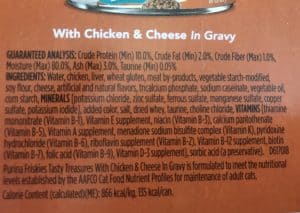
You can get some idea of what your cat is actually eating based on the name of the product on the label. AAFCO regulates labeling depending upon how much of the named protein there is in the food.
If there is only one named ingredient, for example, in a product called Turkey Cat Food, regulations require at least 95% of the food, not including water, has to be turkey. A product with two named ingredients, such as Chicken and Turkey cat food, needs to be 95% of the two ingredients and they must list whichever there is more of first.
If you see something labeled “dinner,” “entrée,” “formula,” “platter” etc, AAFCO defines it as having between 25% and 95% of the named ingredient. So a chicken formula could be mostly tuna. Read the ingredient panels to make sure you know what you are buying especially if your kitty has sensitivities. I’ve read so many cat food labels looking for food that didn’t have chicken for an allergic kitty, only to find that the turkey dinner was more chicken than turkey.
The cat food “with” tuna needs only to have 3% tuna. And a chicken-flavored cat food can contain no chicken at all.
Marketing and Cat Food Labels:
Holistic, premium, super-premium, human-grade ingredients, veterinarian recommended. What do any of these mean when reading a cat food label? Most of it is hype and meaningless because there are no regulatory definitions for the words in the standards. So anyone can put anything on a bag or can or box and call it holistic, premium, select or whatever.
The terms “natural” and “organic” do have defined meanings.
Natural:
Natural means made from plants and animals. Most if not all vitamin supplements are synthetic. Stating that a food product is “natural” doesn’t necessarily signify quality. Food is a natural product. A product described as natural probably doesn’t contain the manufactured preservatives.
Be wary about things that call themselves “all natural” or “100% natural”. If they use a vitamin pack, it will be a synthetic product and thus should not claim all natural.
Organic:
There are specific rules relating to the use of the word “Organic” on a label:
- A product made with 95% organically produced ingredients it may display the USDA Organic seal and be called organic.
- Food with at least 70% organic ingredients can have a label saying it is “made with organic ingredients.”
- If a product has some organic ingredients, but the total is less than 70% the producer can show the organic ingredients in the ingredient panel but can not label the product organic.
Beyond the Cat Food Labels:
There are many other questions to ask when selecting a food but deciphering cat food labels is a good starting point. Don’t stop with the labels on the cans. Often a manufacturer will give more information about their products on their website or promotional information in the store.
If you want more details contact them and ask. I’ve had a different results from doing that. One company passed my message to their vet nutritionist and we had a very productive email conversation. On the other hand, I had a couple of companies reply that what I wanted to know was proprietary information, simply repeat what was on the website or the can, or refuse to answer at all. I’m sure you can guess which food I bought my cats.
Label regulations are evolving. I think the more information we demand when making decisions about our feline friend’s diet the better. Demand moves the market.
Resources:
Catinfo: Commercial Cat Food Information
AAFCO Ingredient Definitions
Cedar Grove Veterinary Services has a pdf on decoding food labels