

High-Rise Syndrome in Cats: Falls from High Places
Last Updated on July 29, 2021 by Holly Anne Dustin
Have you seen the video of the black cat that jumps out the 5th floor window during a fire? Kitty is showing just how cats can set themselves for a good landing in a fall from heights and do well. While cats are famous for their ability to land on all fours from all sorts of heights, this isn’t always the case.
Cats who fall from heights can suffer serious injuries. Some vet practices see 3-5 cases a week, according to the ASPCA. It happens so often that they have given it its own name: high-rise syndrome in cats
Contents
- 1 What is High-Rise Syndrome?
- 2 Cats at Most Risk of High-Rise Syndrome
- 3 How Does High-Rise Syndrome in Cats Happen?
- 4 Why Do Cats Fall From High Places?
- 5 But Don’t Cats Always Land On Their Feet?
- 6 How High Can a Cat Fall From and be Okay?
- 7 How Do You Prevent High-Rise Syndrome in Cats?
- 8 Cat Proof Your Balcony and Supervise Kitty
- 9 Conclusion
What is High-Rise Syndrome?
High-rise syndrome in cats is the common set of injuries that result from a fall from height. A fall from height usually results in head and spinal injuries, broken bones, ruptured tendons and ligaments, shock, and internal injuries.
The most common injuries are facial trauma and dental fractures. High-rise syndrome in cats often involves a fractured jaw because they hit their chins when they land on the ground.
A study into high-rise syndrome in cats done in 1987 showed that most cats taking a long fall have an excellent result. Over 90% of high-rise syndrome cats survive. But it can be a long, painful, and expensive recovery. Costs for treating severe high-rise syndrome cases can run you $2,000 to over $5,000. Kitty will typically stay in the hospital for several days.
Cats at Most Risk of High-Rise Syndrome
Most cats that vets see for high-rise syndrome injuries are active young cats. Most are younger than two, many are kittens under one year of age.
Intact cats are at more risk of high-rise syndrome because they want to get out to sow their wild oats so to speak. Declawed cats are at greater risk because they can’t grab on to anything should they slide.
High-rise syndrome in cats happens more often in warmer climates where windows are open for more of the year, and in cities where high rise living is more common.
How Does High-Rise Syndrome in Cats Happen?
Cats don’t jump out a window on purpose. Kitties fall out a window when a screen falls out. They lie against a loose screen basking in the sun and fall out with the screen. Little screen-climbing kittens can cause the same result.
It isn’t just windows that can cause the problem. Falling from a high perch while sleeping, playing on loft railings and stairways, jumping to a higher ledge or cabinet top or something similar and missing the landing are all common causes of high-rise syndrome that happen in our homes. These shorter falls tend to cause more traumatic injuries than longer falls.
Why Do Cats Fall From High Places?
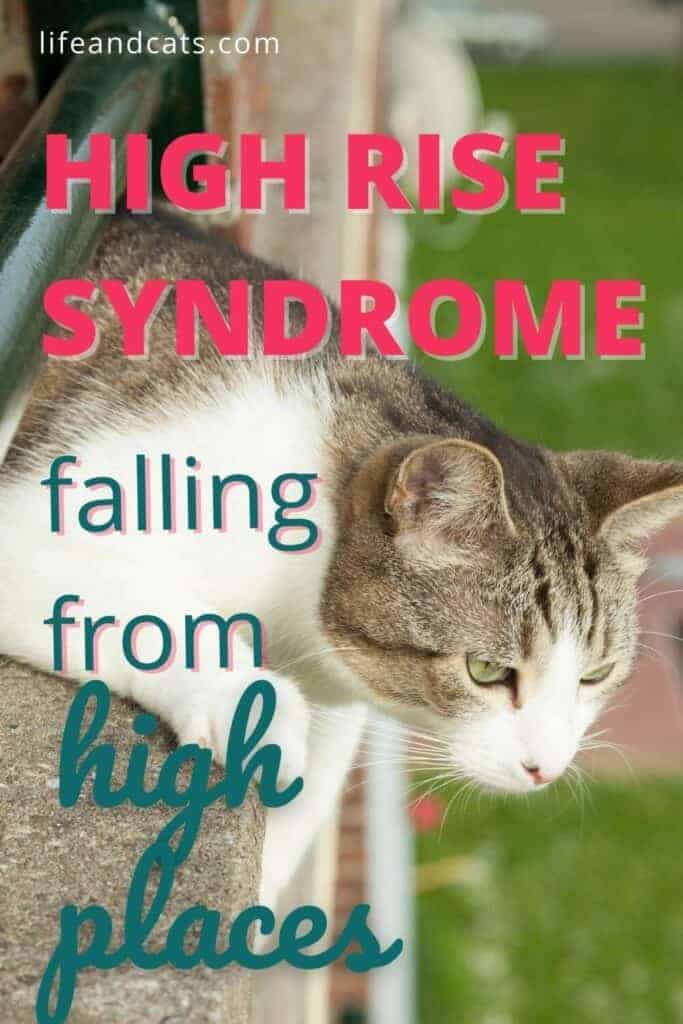
Cats instinctively want to be up high. They will jump up on railings, ledges, high cabinets, balconies and fire escapes and misjudge the width of his landing. Wandering around on concrete or metal leaves them with nothing to grip on if they slip. Distraction from a bird or a gust of wind and Kitty loses her footing and falls.
Falling asleep and rolling off something is another risk. Sleeping cats startle awake in a dream and fall. Or something like the vacuum scares them and they fall off.
I had a big black and white cat that used to love to sleep on the edge of my old CRT monitor. He’d roll off often. It was only a short fall to my desk but I can see how he’d roll off something high and end up with high-rise syndrome.
But Don’t Cats Always Land On Their Feet?
No, that’s a myth. They do have a “righting reflex” that kicks in as a cat falls and a flexible spine. This allows Kitty to orientate himself to land on his paws with his legs splayed. But a fall from low height may not allow him to twist and set himself to land properly. Less mobile cats, like older cats and fat cats, might struggle to right themselves and land correctly.
How High Can a Cat Fall From and be Okay?
When a cat falls from height with the chance to right themselves properly, like the one that jumped from the fire, a cat can survive the drop from over 20 stories intact. Severe impact injuries tend to happen from the more common falls of between 2-7 stories of height. Any cat that falls from height needs to visit the vet. They may look fine, but you can’t see any internal injuries they may have. The full extent of a cat’s injuries sometimes isn’t seen until 48–72 hours later.
This post may contain affiliate links. Life and Cats is a Chewy affiliate and a member of the Amazon Associates program and as such we earn a small commission when you shop through our our links and banners. It doesn’t change the amount you pay. You can read our full disclosure policy here.
How Do You Prevent High-Rise Syndrome in Cats?
High-Rise Syndrome is extremely preventable. We can prevent high-rise syndrome with a little preparation on our part. It is all about common sense and out thinking the cat.
- Check all the screens in the house to make sure they are secure and properly fitted in the window. Consider replacing the mesh with animal proof screening. It is stronger and less likely to give way under the onslaught of kitty claws on a bug hunt.
- Don’t count on child window guards. Cats can get through them.
- Don’t open a window if it doesn’t have a screen, not even a few inches. You’d be amazed at the small spaces a cat can squeeze through.
- Cats can get out through slats on balconies, stairways, lofts and terrace railings. Cover these gaps with netting or wire mesh.
- Consider your furniture placement. Don’t put it where Kitty can use it as a ladder to get to heights that he could fall off.
- Make sure his wall shelves and perches are safe and large enough for your sleeping kitty.

Cat Proof Your Balcony and Supervise Kitty
Cat proof your balcony by building a catio. Or fence the space with mesh and a cat fence extension to keep him away safe inside. If you can’t make permanent alterations because you rent, consider buying a tent or pre-made run. If your management company or HOA objects even to that, then it is safer to keep Kitty off the balcony.
Click here for other ways to provide outdoor enrichment for indoor cats.
Conclusion
A vet should see all cats that have had a fall. As we have seen, shorter falls can cause more severe injuries than a long fall. If Kitty falls from the loft railing or the second-floor window, he is going to have less time to right himself into the proper “landing on his feet ‘’ position and will suffer a more traumatic landing. We need to keep our furbabies safe around heights, just as we do our human children.
Related post: More cat safety tips